Average Costs and Payback Periods for Residential Wind Systems in 2026

For the rural homeowner in 2026, energy independence has taken on a new level of urgency. As utility rates continue to climb and the power grid faces increasing strain from extreme weather, “Distributed Wind”—small-scale turbines designed for individual properties—has emerged as a powerful, albeit complex, alternative to solar.

However, the financial landscape has shifted. With the expiration of the Residential Clean Energy Credit (Section 25D) on December 31, 2025, the “30% off” era has ended. Today’s wind investments are no longer subsidized by federal tax appetites; they must stand on their own mechanical and meteorological merit.

1. The 2026 Cost Reality: Beyond the Turbine

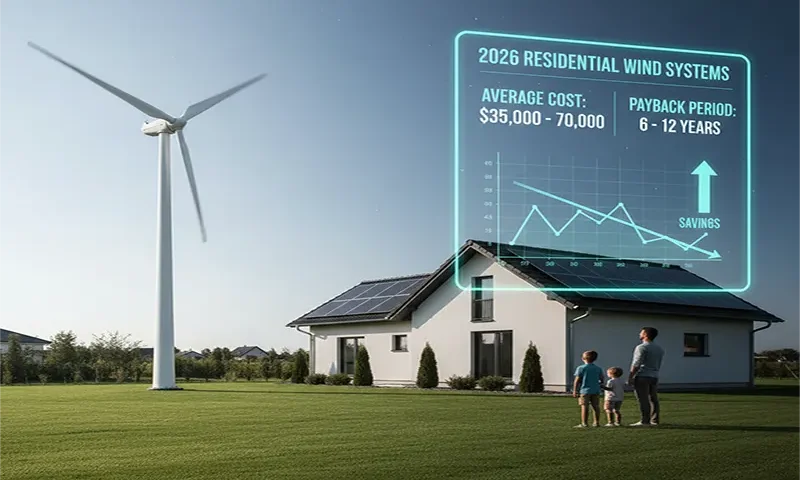
In 2026, the average cost to install a residential wind system ranges from $3,000 to $8,000 per kilowatt (kW) of capacity. For a standard 5kW system—enough to offset a significant portion of an average American home’s usage—homeowners should budget between $30,000 and $45,000.

It is … READ MORE ...

2026 Residential Solar Tax Incentives and the Rise of Prepaid TPO Leases

As of February 2026, the financial playbook for home solar has undergone a radical transformation. The legislative shift brought about by the “One Big Beautiful Bill” (OBBBA) in mid-2025 has effectively bifurcated the market. For homeowners, the era of the direct Section 25D tax credit has ended, replaced by a sophisticated “Third-Party Ownership” (TPO) ecosystem that utilizes the Section 48E Clean Electricity Investment Credit.

For the modern homeowner or real estate investor, the challenge is no longer just selecting panels; it is selecting a financial structure that captures federal incentives that are now exclusively available to commercial entities.

1. The 2026 Policy Divide: Section 25D vs. Section 48E

To understand the 2026 market, one must distinguish between the two primary sections of the tax code that govern solar energy.

The Sunset of Section 25D (Direct Ownership)

Historically, homeowners who purchased their systems with cash or a loan used Section … READ MORE ...

Best Perovskite-Silicon Tandem Solar Panels for Residential Use in 2026

For decades, the solar industry has been chasing the “30% barrier.” Traditional silicon panels, which currently power over 95% of the world’s rooftops, are fast approaching their theoretical ceiling—known as the Shockley-Queisser (S-Q) limit. As we navigate 2026, the breakthrough that once lived only in laboratories has finally arrived on the residential market: Perovskite-Silicon Tandem Solar Panels.

By stacking a perovskite layer on top of a standard silicon base, manufacturers are now shipping modules that produce up to 25% more power from the same roof footprint. For the 2026 homeowner, this technology represents the transition from “standard” efficiency to “ultra-high” yield.

1. Breaking the Shockley-Queisser Limit

The fundamental limit for a single-junction silicon solar cell is approximately $29.4\%$. In real-world manufacturing, this translates to module efficiencies that top out around $23\text{–}24\%$. Tandem cells bypass this by using a “double-decker” architecture.

How Tandem Cells Work

Perovskite materials are “tunable,” … READ MORE ...

Navigating the 2026 Federal Residential Clean Energy Tax Credit for Wind Turbines

As of February 2026, the landscape for residential renewable energy has undergone a significant transformation. Following the enactment of the One Big Beautiful Bill (OBBB) Act in July 2025, the generous pathways established by the Inflation Reduction Act (IRA) have been narrowed. While the 30% Residential Clean Energy Credit (Section 25D) technically remains the headline rate, the 2026 requirements introduce rigorous new “Physical Work” tests and domestic content hurdles that did not exist two years ago.

For homeowners, 2026 is a “use it or lose it” year. Navigating these new federal mandates is no longer just about buying a turbine; it is about proving a timeline of significant on-site construction and verified domestic sourcing.

The 2026 Policy Pivot: BOC and Termination Dates

The most critical change in 2026 is the implementation of the “Beginning of Construction” (BOC) deadline. Under the OBBB Act and subsequent Treasury Notice 2025-42, wind projects are … READ MORE ...

The Autonomous Prosumer: AI-Powered Home Solar Energy Management and the V2H Revolution

For decades, home solar was a passive investment: you installed panels, and they fed power to your toaster or the grid. But as we move through 2026, the paradigm has shifted from passive consumption to predictive orchestration. The home is no longer just a building; it is a sophisticated microgrid.

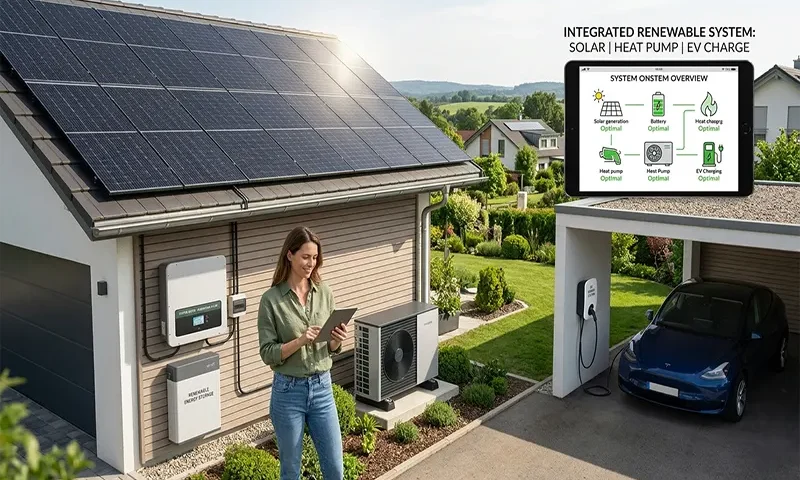
The catalyst for this transformation is the convergence of AI-Native Home Energy Management Systems (HEMS) and Vehicle-to-Home (V2H) charging. By treating the electric vehicle (EV) as a massive, mobile battery and the home as an intelligent “energy brain,” homeowners are achieving a level of energy sovereignty previously reserved for utility-scale operations.

The Engine: AI Orchestration and Predictive Analytics

The “smart” homes of five years ago relied on simple “if-then” rules. Today’s AI-powered HEMS utilize predictive analytics to make hundreds of decisions per hour. These systems don’t just see that the sun is shining; they understand why it matters.

1.

READ MORE ...