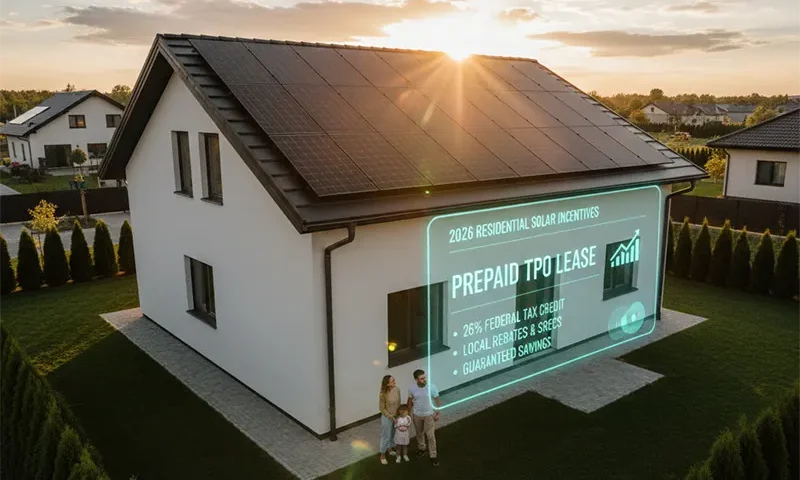
2026 Residential Solar Tax Incentives and the Rise of Prepaid TPO Leases

As of February 2026, the financial playbook for home solar has undergone a radical transformation. The legislative shift brought about by the “One Big Beautiful Bill” (OBBBA) in mid-2025 has effectively bifurcated the market. For homeowners, the era of the direct Section 25D tax credit has ended, replaced by a sophisticated “Third-Party Ownership” (TPO) ecosystem that utilizes the Section 48E Clean Electricity Investment Credit.

For the modern homeowner or real estate investor, the challenge is no longer just selecting panels; it is selecting a financial structure that captures federal incentives that are now exclusively available to commercial entities.

1. The 2026 Policy Divide: Section 25D vs. Section 48E

To understand the 2026 market, one must distinguish between the two primary sections of the tax code that govern solar energy.

The Sunset of Section 25D (Direct Ownership)

Historically, homeowners who purchased their systems with cash or a loan used Section … READ MORE ...

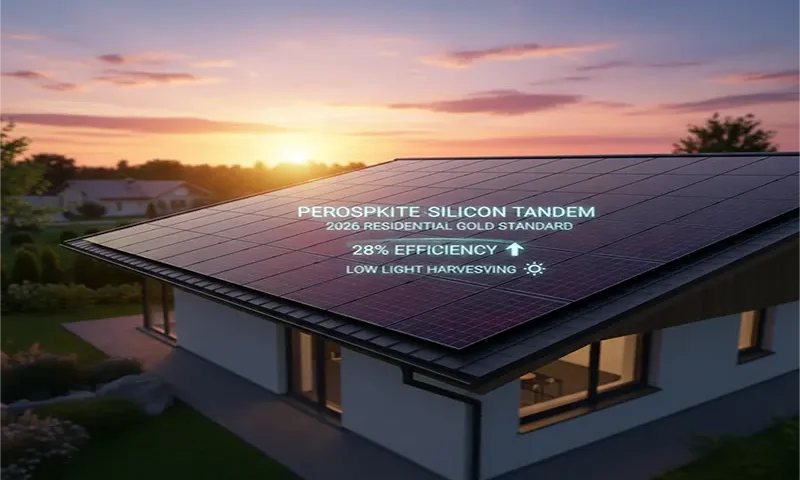
Best Perovskite-Silicon Tandem Solar Panels for Residential Use in 2026

For decades, the solar industry has been chasing the “30% barrier.” Traditional silicon panels, which currently power over 95% of the world’s rooftops, are fast approaching their theoretical ceiling—known as the Shockley-Queisser (S-Q) limit. As we navigate 2026, the breakthrough that once lived only in laboratories has finally arrived on the residential market: Perovskite-Silicon Tandem Solar Panels.

By stacking a perovskite layer on top of a standard silicon base, manufacturers are now shipping modules that produce up to 25% more power from the same roof footprint. For the 2026 homeowner, this technology represents the transition from “standard” efficiency to “ultra-high” yield.

1. Breaking the Shockley-Queisser Limit

The fundamental limit for a single-junction silicon solar cell is approximately $29.4\%$. In real-world manufacturing, this translates to module efficiencies that top out around $23\text{–}24\%$. Tandem cells bypass this by using a “double-decker” architecture.

How Tandem Cells Work

Perovskite materials are “tunable,” … READ MORE ...

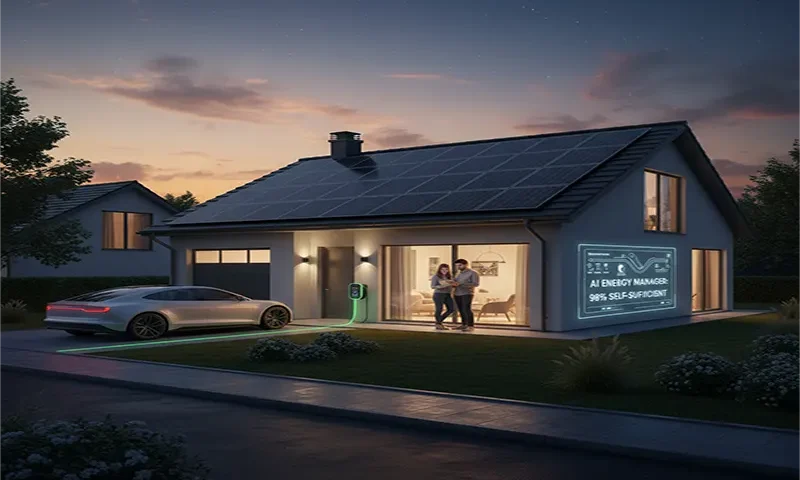
The Autonomous Prosumer: AI-Powered Home Solar Energy Management and the V2H Revolution

For decades, home solar was a passive investment: you installed panels, and they fed power to your toaster or the grid. But as we move through 2026, the paradigm has shifted from passive consumption to predictive orchestration. The home is no longer just a building; it is a sophisticated microgrid.

The catalyst for this transformation is the convergence of AI-Native Home Energy Management Systems (HEMS) and Vehicle-to-Home (V2H) charging. By treating the electric vehicle (EV) as a massive, mobile battery and the home as an intelligent “energy brain,” homeowners are achieving a level of energy sovereignty previously reserved for utility-scale operations.

The Engine: AI Orchestration and Predictive Analytics

The “smart” homes of five years ago relied on simple “if-then” rules. Today’s AI-powered HEMS utilize predictive analytics to make hundreds of decisions per hour. These systems don’t just see that the sun is shining; they understand why it matters.

1.

READ MORE ...
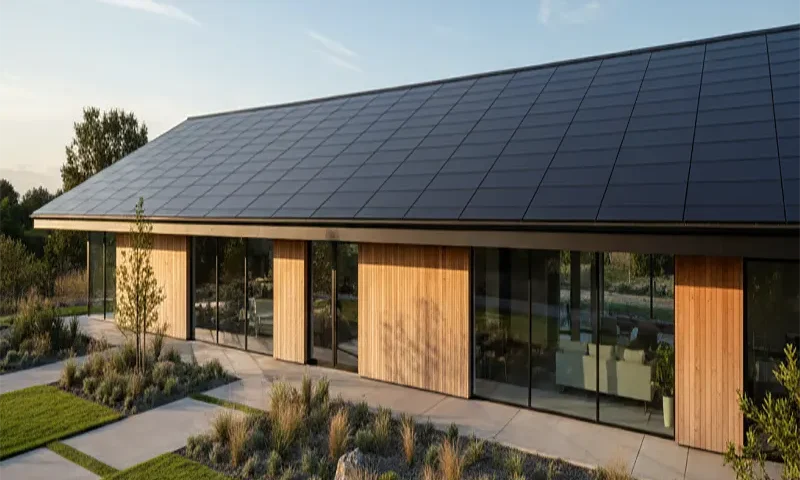
Invisible Energy: Building-Integrated Photovoltaics for Modern Home Roof Aesthetics

For decades, the adoption of solar energy was often a compromise between environmental conscience and architectural integrity. Homeowners were forced to choose between carbon neutrality and the visual harmony of their rooflines. We are now firmly past the “Bolt-On” era. The traditional blue-black rectangles of Building-Applied Photovoltaics (BAPV), held aloft by unsightly aluminum rails, are being replaced by a more elegant solution: Building-Integrated Photovoltaics (BIPV).

In 2026, the roof is no longer just a passive shield against the elements; it is an active, power-generating skin. BIPV represents the ultimate convergence of structural engineering and renewable energy, where the solar cell is the building material itself.

The 2026 BIPV Technology Landscape

The transition from “solar panels” to “solar surfaces” has been driven by three primary technological breakthroughs that have matured significantly this year.

1. Solar Tiles and Modern Shingles

Companies like Tesla and GAF Energy have refined the solar shingle to … READ MORE ...

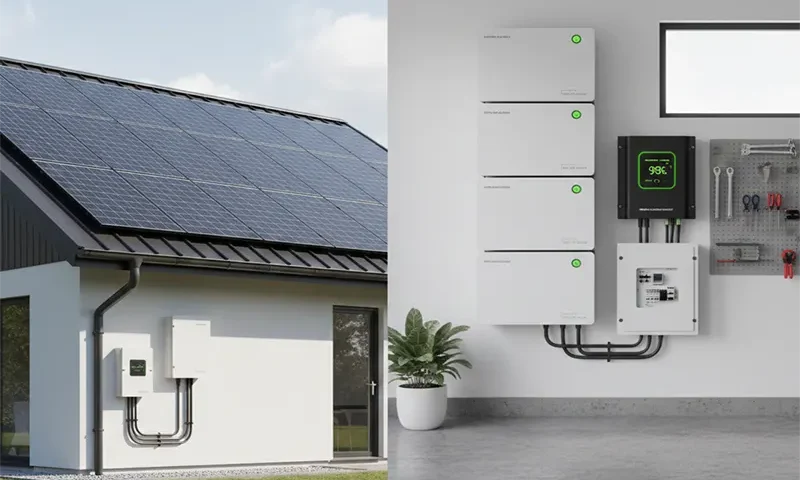
Whole House Solar Battery Backup Systems for Off-Grid Resilience

In 2026, the American energy landscape is undergoing a fundamental shift. Aging grid infrastructure, combined with the increasing frequency of extreme weather events, has moved residential energy storage from a “green luxury” to an essential component of home resilience. Homeowners are no longer satisfied with simple “partial backup”—the ability to keep a few lights and a refrigerator running. The modern standard is Energy Sovereignty: the capacity for a home to operate in Islanded Mode indefinitely, maintaining full lifestyle continuity regardless of grid status.

The Resilience Mandate: Energy vs. Power

To understand a whole-house backup system, one must first distinguish between two critical metrics: Energy (kWh) and Power (kW).

  • Energy (Kilowatt-hours): This is the size of your “fuel tank.” A 20kWh battery can theoretically run a 1kW load for 20 hours. It determines how long you can stay off-grid.
  • Power (Kilowatts): This is the “size of the pipe.” It
READ MORE ...