
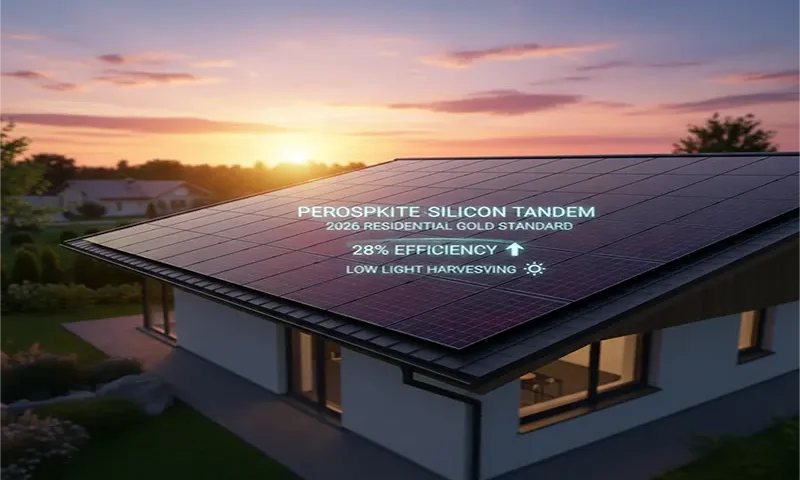
Best Perovskite-Silicon Tandem Solar Panels for Residential Use in 2026
For decades, the solar industry has been chasing the “30% barrier.” Traditional silicon panels, which currently power over 95% of the world’s rooftops, are fast approaching their theoretical ceiling—known as the Shockley-Queisser (S-Q) limit. As we navigate 2026, the breakthrough that once lived only in laboratories has finally arrived on the residential market: Perovskite-Silicon Tandem Solar Panels.
By stacking a perovskite layer on top of a standard silicon base, manufacturers are now shipping modules that produce up to 25% more power from the same roof footprint. For the 2026 homeowner, this technology represents the transition from “standard” efficiency to “ultra-high” yield.
1. Breaking the Shockley-Queisser Limit
The fundamental limit for a single-junction silicon solar cell is approximately $29.4\%$. In real-world manufacturing, this translates to module efficiencies that top out around $23\text{–}24\%$. Tandem cells bypass this by using a “double-decker” architecture.
How Tandem Cells Work
Perovskite materials are “tunable,” … READ MORE ...
