Maximizing Returns: 2026 Residential Solar Tax Incentives and the Rise of Prepaid TPO Leases

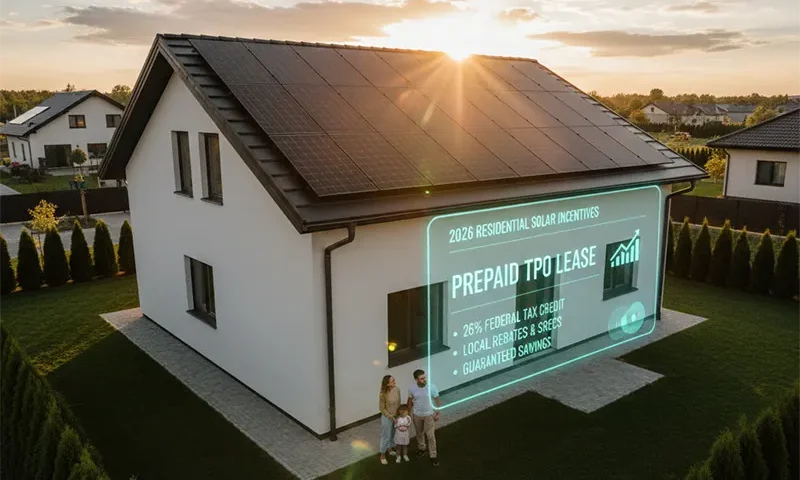
As of February 2026, the financial playbook for home solar has undergone a radical transformation. The legislative shift brought about by the “One Big Beautiful Bill” (OBBBA) in mid-2025 has effectively bifurcated the market. For homeowners, the era of the direct Section 25D tax credit has ended, replaced by a sophisticated “Third-Party Ownership” (TPO) ecosystem that utilizes the Section 48E Clean Electricity Investment Credit.

For the modern homeowner or real estate investor, the challenge is no longer just selecting panels; it is selecting a financial structure that captures federal incentives that are now exclusively available to commercial entities.

1. The 2026 Policy Divide: Section 25D vs. Section 48E

To understand the 2026 market, one must distinguish between the two primary sections of the tax code that govern solar energy.

The Sunset of Section 25D (Direct Ownership)

Historically, homeowners who purchased their systems with cash or a loan used Section 25D to claim a 30% credit. Under the OBBB Act, Section 25D expired on December 31, 2025. Any system purchased and owned directly by a homeowner in 2026 is ineligible for federal tax credits.

The Survival of Section 48E (TPO)

In contrast, Section 48E—the commercial investment credit—remains active through December 31, 2027. This credit is claimed by businesses that own and operate solar facilities. By using a TPO model, such as a lease or PPA, a solar financing company “owns” the panels on your roof, claims the credit, and passes the value back to you via lower costs.… READ MORE ...

The New Dawn of Efficiency: Best Perovskite-Silicon Tandem Solar Panels for Residential Use in 2026

For decades, the solar industry has been chasing the “30% barrier.” Traditional silicon panels, which currently power over 95% of the world’s rooftops, are fast approaching their theoretical ceiling—known as the Shockley-Queisser (S-Q) limit. As we navigate 2026, the breakthrough that once lived only in laboratories has finally arrived on the residential market: Perovskite-Silicon Tandem Solar Panels.

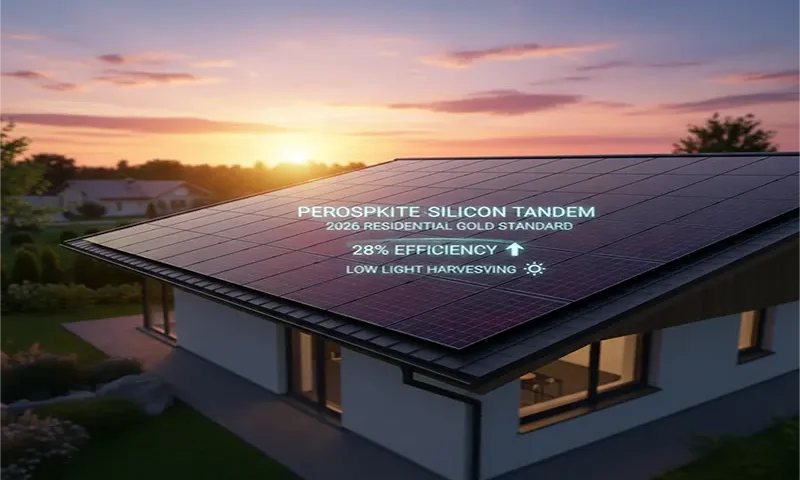
By stacking a perovskite layer on top of a standard silicon base, manufacturers are now shipping modules that produce up to 25% more power from the same roof footprint. For the 2026 homeowner, this technology represents the transition from “standard” efficiency to “ultra-high” yield.

1. Breaking the Shockley-Queisser Limit

The fundamental limit for a single-junction silicon solar cell is approximately $29.4\%$. In real-world manufacturing, this translates to module efficiencies that top out around $23\text{–}24\%$. Tandem cells bypass this by using a “double-decker” architecture.

How Tandem Cells Work

Perovskite materials are “tunable,” meaning they can be engineered to absorb high-energy blue and ultraviolet light that silicon typically wastes as heat.

  • The Top Layer (Perovskite): Captures high-energy, short-wavelength photons.
  • The Bottom Layer (Silicon): Captures lower-energy, long-wavelength infrared photons that pass through the top layer.

By splitting the solar spectrum, tandem modules in 2026 are reaching commercial efficiencies of $26.9\%\text{–}28.5\%$, with laboratory prototypes already shattering the $34\%$ mark.

2. Top Residential Players & Modules in 2026

As of early 2026, three major manufacturers have taken the lead in bringing tandem technology to the consumer market.

Oxford PV: The Centaur™ Series

The UK/German-based Oxford READ MORE ...

Fortresses of Warmth: Contemporary Passive House Floor Plans for Cold Climate Efficiency

In the architectural landscape of 2026, the definition of a “home” has shifted. As climate volatility introduces more frequent and severe polar vortices, the Passive House standard has graduated from a niche environmental goal to a critical blueprint for absolute resilience. In cold climates, a modern floor plan is no longer just about aesthetics; it is a thermal strategy—a “Fortress of Warmth” designed to maintain habitable temperatures for weeks, even during total grid failure.

The 2026 Passive House—certified by the Passive House Institute (PHI) or Phius—utilizes the latest in vacuum insulation, bio-based structural cores, and AI-driven thermal orchestration to achieve a 90% reduction in heating energy compared to legacy building stock.

1. The Anatomy of a Cold-Climate Envelope

To survive sub-zero winters, the building envelope must transition from a “skin” to a high-performance “shield.”

Super-Insulation & The CLT Revolution

Traditional stick-framing is being replaced by Cross-Laminated Timber (CLT). CLT acts as both structure and thermal mass, sequestering carbon while providing a continuous surface that eliminates thermal bridges. In 2026, these cores are augmented with Vacuum Insulation Panels (VIPs), which offer R-values up to $R\text{–}40$ in just one inch of thickness.

Quad-Pane Glazing: The New Standard

Triple-pane windows were once the gold standard; today, cold-climate Passive Houses utilize Quad-pane, krypton-filled units. These windows feature a U-value as low as $0.60\ W/m^2K$, ensuring that the interior glass surface remains warm to the touch even when it is $-20^\circ C$ outside.

2. Floor Plan Strategy: The ‘Compact Volume’

READ MORE ...