
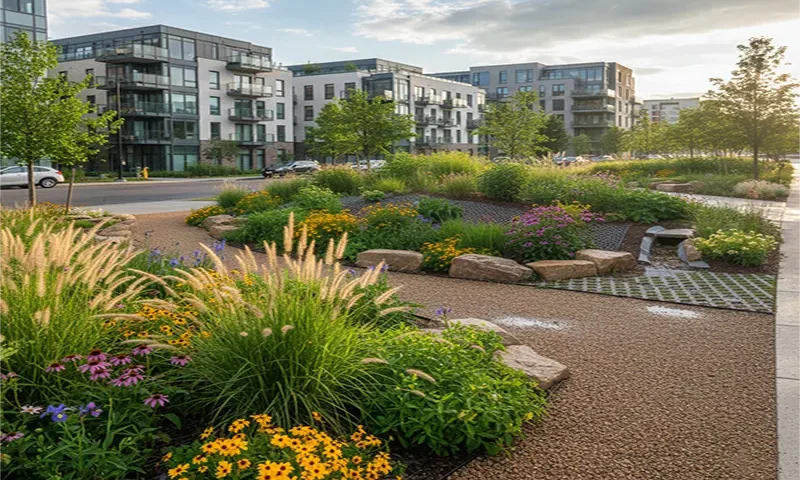
Sponge City Solutions: Climate-Resilient Rain Garden Plant Palettes for Urban Stormwater Management
The year 2026 has solidified a new paradigm in urban planning: the “Sponge City.” As cities face the compounding pressures of the Urban Heat Island (UHI) effect and increasingly volatile precipitation patterns, the traditional “gray” infrastructure of concrete pipes and sewers is no longer sufficient. Enter Green Stormwater Infrastructure (GSI)—specifically the climate-resilient rain garden.
A modern rain garden is not merely a collection of water-loving plants; it is a sophisticated bioretention system designed to bridge the gap between two environmental extremes: 48 hours of total soil saturation followed by weeks of intense, reflective urban heat. Success in this dual-stress environment requires a shift from ornamental selection to a rigorous “adaptive native” philosophy.
The Bioretention Anatomy: Engineering for Life
To the casual observer, a rain garden looks like a shallow flower bed. Below the surface, however, it is a high-performance filter. A resilient cell typically consists of:
- Engineered Soil Media
