
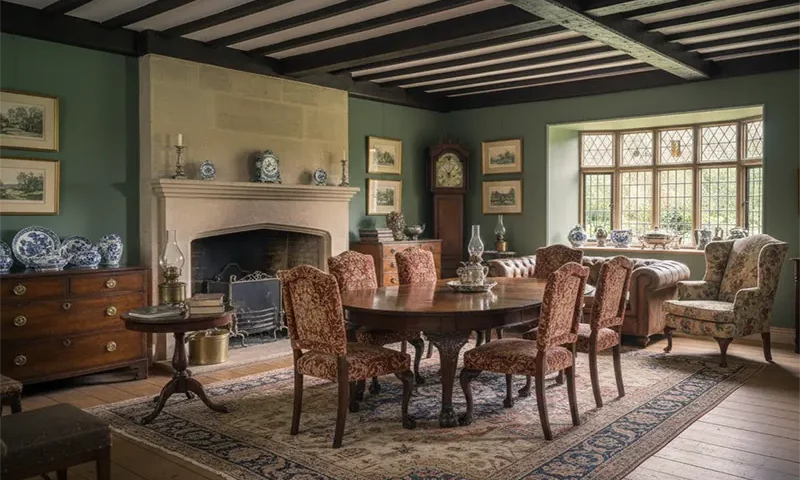
In the world of interior design, the “English Cottage” is a term often diluted by mass-produced replicas and distressed paint. However, the Elevated English Cottage—the kind found in the rolling hills of the Cotswolds or the coastal retreats of Cornwall—eschews the “shabby chic” for something far more substantial. The soul of these interiors lies in the patina of time, a soft glow that can only be earned through centuries of beeswax, sunlight, and human touch.
To achieve this look, one must look toward authentic, pre-1920s antique furniture. These pieces act as anchors, providing a sense of historical gravity that grounds the whimsical patterns and moody palettes of a modern country home.
The Wood Chronology: A History of Texture
To understand English antiques, one must understand the wood. Collectors often refer to the “Ages” of furniture, a chronology popularized by historian Percy Macquoid that dictates the mood of a room.
- The Age of Oak (1500–1660): The earliest cottage pieces are oak. This wood is heavy, dark, and incredibly durable. It represents the “primitive” heart of the cottage—think refectory tables and settle benches that have survived four centuries of use.
- The Age of Walnut (1660–1720): Walnut introduced a more refined, honey-colored elegance. This era brought about marquetry and veneering, adding a layer of sophisticated “luxe” to the previously rugged interior.
- The Age of Mahogany (1720–1800): Mahogany is the king of the “elevated” look. Its dense grain allowed for the delicate, airy carvings of Chippendale and Hepplewhite. In a cottage, a single mahogany piece prevents the space from feeling too “farmhouse.”
Key Period Pieces for the Elevated Living Room
The Gateleg Table
A staple of the 17th-century home, the Gateleg Table is the ultimate versatile piece for small cottage footprints. Its drop-leaf design allows it to sit against a wall as a console or open up for an intimate dinner by the fire. Look for examples with “barley-twist” legs, a hallmark of the Carolean period (1660–1685).
The Wingback Chair
Authentic early Georgian wingbacks were designed for a functional purpose: to trap the heat of the fire and protect the sitter from drafts. An elevated interior uses an original frame with its high, noble silhouette, often reupholstered in a heavy Belgian linen or a muted William Morris print to bridge the gap between 1720 and 2026.
The Welsh Dresser
In an elevated cottage, the Welsh Dresser is more than just plate storage; it is the room’s focal point. While rustic versions are common, a “refined” dresser from the late 18th century often features delicate inlay work (fruitwood or boxwood) and elegant cabriole legs, elevating it from utility to art.
Essential English Antique Styles by Era
| Era | Primary Wood | Style Characteristics | Ideal Placement |
| Jacobean (1603-1625) | Oak | Heavy, dark, geometric carvings | Entryway / Hall |
| Queen Anne (1702-1714) | Walnut | Graceful curves, cabriole legs | Bedroom / Study |
| Georgian (1714-1830) | Mahogany | Symmetry, refined carvings, inlay | Dining Room |
| Arts & Crafts (1880-1910) | Oak / Fruitwood | Visible joinery, honest, simple | Kitchen / Library |
Identifying Authenticity: The Detective’s Guide
Spotting a true pre-1920s antique requires looking where the craftsman thought no one would see.
- Hand-Cut Dovetails: Open a drawer. If the dovetails (the interlocking joints) are perfectly identical and thin, they are machine-cut (post-1860). Authentic early pieces have slightly uneven, chunky “tails” and “pins,” showing the marks of a hand saw and chisel.
- The Plane and the Pit-Saw: Run your hand along the back or underside of a chest of drawers. You should feel slight undulations. This is the mark of a hand plane. Look for straight, slightly irregular saw marks; circular marks indicate a power saw, which places the piece firmly in the mid-to-late 19th century or later.
- The Hardware: Authentic brass hardware from the 18th century was hand-cast and will have a soft, “poured” texture. If you look at the back of a swan-neck handle, you should see a hand-threaded nut, not a modern Phillips-head screw.
The Art of the Mix: Curation Tips
The danger of decorating with antiques is creating a “museum” feel. To achieve the Elevated English Cottage look, you must master the art of the mix.
- Layering Textures: Pair a heavy, dark oak coffer with a soft, oversized velvet sofa. The contrast between the rigid, 300-year-old wood and the plush, modern textile creates an immediate sense of comfort.
- Moody Palettes: “Brown furniture” (as decorators call it) looks best against saturated colors. A mahogany tallboy pops against a wall painted in “Dead Salmon” or “Railings” (Farrow & Ball).
- The “One Great Piece” Rule: In a small cottage room, don’t overcrowd. One significant Arts & Crafts bookcase from the late 1800s carries more weight than five smaller, mid-century reproductions.
The Luxury of Permanence
Investing in pre-1920s English furniture is, ultimately, an act of sustainability. These pieces were built using tenon joinery and solid timber, designed to be repaired rather than replaced. In an age of “fast furniture,” a 200-year-old mahogany chest isn’t just a decorative choice; it’s a commitment to a slower, more intentional way of living. It provides the “elevated” cottage with its most essential ingredient: a story.

