
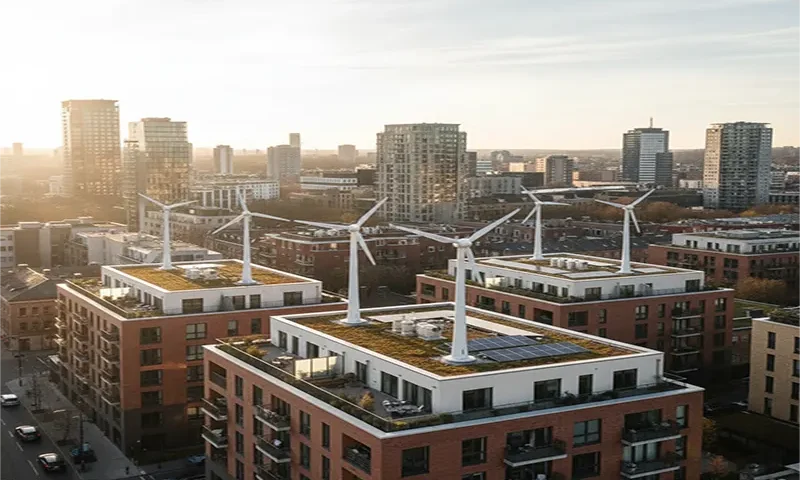
As cities transition toward decentralized green energy in 2026, a new silhouette is appearing on the urban skyline. Moving beyond the massive, three-bladed giants seen in rural wind farms, a more compact and elegant technology is taking over city rooftops: the Vertical Axis Wind Turbine (VAWT). Designed specifically to thrive where traditional turbines fail, VAWTs are the key to unlocking the untapped energy potential of the “urban canyon.”
The Urban Wind Challenge: Why Cities Need VAWTs
Traditional Horizontal Axis Wind Turbines (HAWTs)—the ones that look like giant fans—are designed for the “laminar” flow of open plains, where wind blows steadily from a single direction. In a city, however, wind is “dirty.” It hits skyscrapers, bounces off pavement, and creates chaotic, multi-directional turbulence.
A standard turbine on an urban rooftop spends most of its energy trying to “yaw” (turn) into the wind. This constant hunting causes mechanical stress, excessive vibration, and a significant drop in efficiency. VAWTs solve this by being omnidirectional. Their blades rotate around a vertical shaft, meaning they can catch wind from the North, South, or a sudden updraft from the street below without ever needing to pivot.
The Quiet Revolution: Engineering Silence
For years, the biggest barrier to residential wind was the “thump-thump” of blades and the high-pitched whine of the generator. In 2026, three major engineering shifts have made VAWTs nearly silent—often quieter than the ambient hum of a city street (operating below 40 dB, or roughly the level of a whisper).
1. Helical (Twisted) Blade Designs
Early vertical turbines had straight blades that experienced a “pulsing” effect as they caught and released the wind. Modern helical designs, like the twisted-H rotor, ensure that at least part of the blade is always catching the wind at the optimal angle. This smooths out the torque, eliminating the rhythmic thumping and reducing mechanical vibration to negligible levels.
2. Lower Tip-Speed Ratios (TSR)
Noise in wind turbines is largely a function of how fast the tips of the blades move through the air. While HAWT blades can reach speeds several times faster than the wind itself (creating aerodynamic “whooshing”), VAWTs typically operate at lower tip speeds. This makes them significantly safer for birds and virtually silent to the human ear.
3. Maglev (Magnetic Levitation) Bearings
One of the most exciting advancements in 2026 is the integration of Maglev technology. By using powerful permanent magnets to “float” the turbine rotor, engineers have eliminated physical contact between the spinning shaft and the stationary base. With no friction from traditional ball bearings, the mechanical whine vanishes, and the “cut-in” wind speed (the minimum wind needed to start spinning) drops significantly.
5 Maintenance Tips for Rooftop VAWTs
While VAWTs have fewer moving parts than their horizontal cousins, rooftop environments are harsh. To ensure your turbine lasts 20+ years, follow these steps:
- Inspect Vibration Isolators: Every six months, check the rubber or elastomeric mounts at the base. These are the “shock absorbers” that prevent the turbine’s movement from echoing through your home’s structure.
- Check the Braking System: Most urban VAWTs use an electronic “dump load” brake to prevent overspeeding during storms. Ensure the resistors are clear of debris and the software is updated.
- Clean the Blades: Urban air is full of soot and dust. A buildup of grime can change the airfoil shape, reducing efficiency by up to 10%. A simple annual wipe-down with a damp cloth is usually sufficient.
- Monitor the Inverter: The “brain” of your system converts the turbine’s wild AC into usable DC or grid-synced AC. Check the app for any “clipping” or error codes that might indicate a failing capacitor.
- Listen for the “Cello Effect”: If you begin to hear a low-frequency hum inside your top-floor rooms, it’s a sign that a mounting bolt has loosened or an isolator has hardened. Early intervention prevents structural fatigue.
Overcoming the “Cello Effect”: Vibration Isolation
In an apartment or residential setting, the biggest noise concern isn’t actually the air—it’s the structure. When a turbine is bolted directly to a roof, it can act like a bow on a cello, sending low-frequency vibrations down through the beams and walls of the building.
To combat this, 2026 residential plans utilize dual-stage vibration isolation. The turbine is mounted on a heavy, damped baseplate, which sits on top of specialized elastomeric “feet.” This decoupled design ensures that even if the turbine is spinning at full capacity during a gusty night, the residents below won’t feel or hear a thing.
Energy Output and ROI: What to Expect
A typical residential VAWT for an urban rooftop is rated between 1kW and 3kW. In a moderately windy city (average speeds of 5–6 m/s), a 1.5kW helical turbine can generate roughly 150–250 kWh per month.
- The Hybrid Advantage: On its own, a rooftop turbine might take 10–12 years to pay for itself. However, when paired with solar panels, the ROI drops to 6–8 years. Wind is strongest at night and during stormy winter months—exactly when solar production is at its lowest.
- Property Value: In 2026, “Energy Autonomy” is a major selling point. Buildings with integrated wind and solar often command a premium in the real estate market.
The Future of Urban Autonomy
Vertical Axis Wind Turbines represent the final piece of the urban energy puzzle. By harnessing the turbulent airflows that were once considered a nuisance, homeowners can finally achieve true 24/7 renewable generation. As helical designs and maglev bearings become the industry standard, the “noisy” wind turbine is a thing of the past. Today’s urban wind power is quiet, constant, and—most importantly—integrated into the very fabric of the modern sustainable home.

