
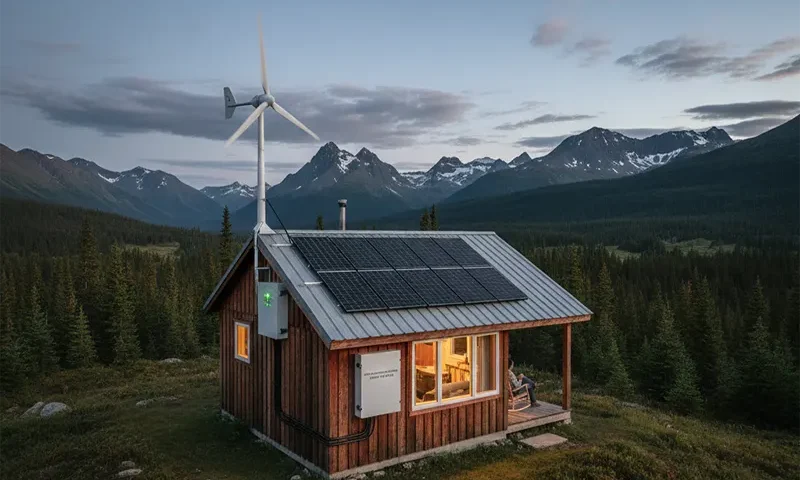
For the off-grid cabin owner, the transition into 2026 has brought a vital realization: solar alone is often not enough. While photovoltaic (PV) panels are the workhorses of summer, the “Solar Winter”—characterized by shorter days, low sun angles, and persistent cloud cover—can leave a battery bank dangerously depleted just when heating and lighting needs are at their peak.
The solution is the Hybrid Energy System. By pairing solar panels with a wind turbine, cabin owners can tap into the “Complementary Resource Effect.” In most temperate and mountainous regions, wind speeds are statistically higher during the night and throughout the winter months, precisely when solar production is at its nadir.
The Seasonal Reliability Gap: Why Hybrid Wins
A standalone 5kW solar system in a northern latitude might produce 25kWh/day in July, but drop to less than 4kWh/day in December. A hybrid system levels this production curve. Wind energy is not just a backup; it is a seasonal bridge that prevents deep-cycle batteries from resting in a state of low charge, which is the primary cause of premature battery failure.
Solar vs. Wind: Performance by Season
| Season | Solar Potential | Wind Potential | System Synergy |
| Summer | Peak (High) | Low to Moderate | Solar carries the heavy AC/cooling loads. |
| Fall | Declining | Increasing | Wind begins to offset shorter daylight hours. |
| Winter | Lowest | Peak (High) | Wind provides “base-load” for heating/lights. |
| Spring | Increasing | High | Maximum system output; ideal for battery equalization. |
System Architecture for 2026: The Hybrid Inverter
The “brain” of a 2026 cabin system is the Hybrid MPPT Controller or a dedicated Hybrid Inverter. Older systems required separate controllers for wind and solar, often leading to “component chatter” where one charger would shut down because it sensed the high voltage of the other.
Modern 2026 kits feature Multi-Channel MPPT (Maximum Power Point Tracking). This allows the system to independently optimize the high-voltage DC from solar panels and the variable three-phase AC from the wind turbine simultaneously. This integration ensures that even a light breeze at 2 AM is contributing to the battery bank without conflicting with the previous day’s solar harvest.
Top 3 Hybrid Kit Archetypes for 2026
1. The Weekend Escape (1kW – 2kW)
- Best For: Small hunting cabins or summer retreats with light winter use.
- Kit Specs: 800W Solar (N-type panels) + 400W Vertical Axis Wind Turbine (VAWT).
- Why it works: These kits are often 24V systems, making them safer for DIY installation. The VAWT is prioritized here for its low noise and ability to catch turbulent wind in forested areas.
2. The Full-Time Off-Grid Residence (5kW – 10kW)
- Best For: Year-round living, remote work, and moderate appliance use.
- Kit Specs: 4kW – 6kW Solar + 2kW Horizontal Axis Wind Turbine (HAWT) on a 50ft tower.
- Why it works: This is a 48V “Powerhouse” system. It utilizes high-efficiency N-type TOPCon panels, which offer superior low-light performance. The HAWT provides much higher raw power output, essential for running well pumps and refrigeration through a week of winter storms.
3. The “Extreme Environment” Build
- Best For: Coastal cabins or high-altitude ridges.
- Kit Specs: Bifacial Solar Panels (capturing light from snow reflection) + Marine-grade Carbon Fiber Turbines.
- Why it works: These kits feature turbines with Electromagnetic Braking and mechanical furling to survive 100mph gusts. The batteries are typically Lithium Iron Phosphate (LFP) with integrated heaters to maintain charging capacity in sub-zero temperatures.
The Sizing Science: The 3:1 Ratio
A common mistake in 2026 is over-investing in wind. Because wind is less “predictable” than the sun, engineers recommend a 3:1 Solar-to-Wind wattage ratio.
For example, if you need 4,000W of total potential, a configuration of 3,000W of solar and 1,000W of wind is usually the “sweet spot.” This ensures you have plenty of power during the sunny months to fully charge batteries and run heavy loads, while the 1,000W of wind provides enough “trickle” to keep the system alive and healthy during a three-day blizzard.
Vertical (VAWT) vs. Horizontal (HAWT) Turbines
The most debated topic in 2026 cabin design is turbine orientation:
- Horizontal Axis (HAWT): These look like traditional windmills. They are highly efficient but require a high, clear tower (30ft+ above any obstacles) to avoid “dirty” turbulent air. They can be noisy and are prone to vibration.
- Vertical Axis (VAWT): These “egg-beater” or “helical” designs are the 2026 favorite for cabins. They don’t care which way the wind is blowing, they are nearly silent, and they can be mounted at lower heights. While they produce less raw power than an equivalent HAWT, their Cut-in Speed is often lower (starting as low as 2 m/s), meaning they generate power more often, even if it’s in smaller amounts.
Technical Challenges: Vibration and Mounting
The #1 complaint with cabin wind systems is Harmonic Vibration. If you bolt a wind turbine directly to a log cabin’s roof, the structure will act like a giant violin, amplifying the turbine’s hum throughout the bedrooms.
2026 Best Practices:
- Free-Standing Towers: Always mount the turbine on a separate guyed or tilt-up tower at least 50 feet away from the cabin.
- Rubber Dampeners: Use industrial-grade vibration isolators between the turbine and the mounting plate.
- The 30/500 Rule: For maximum efficiency, a turbine should be 30 feet higher than anything within 500 feet. In a forest, this means your tower must clear the tree canopy.
Total Energy Sovereignty
Investing in a hybrid solar and wind kit is about more than just “free power”; it is about removing the anxiety of the “Low Battery” alarm. By diversifying your energy harvest, you are mimicking the resilience of nature itself. In the world of 2026 off-grid living, the hybrid system represents the pinnacle of energy sovereignty—ensuring that whether the sun is shining or the storm is howling, your cabin remains a warm, powered sanctuary.

