
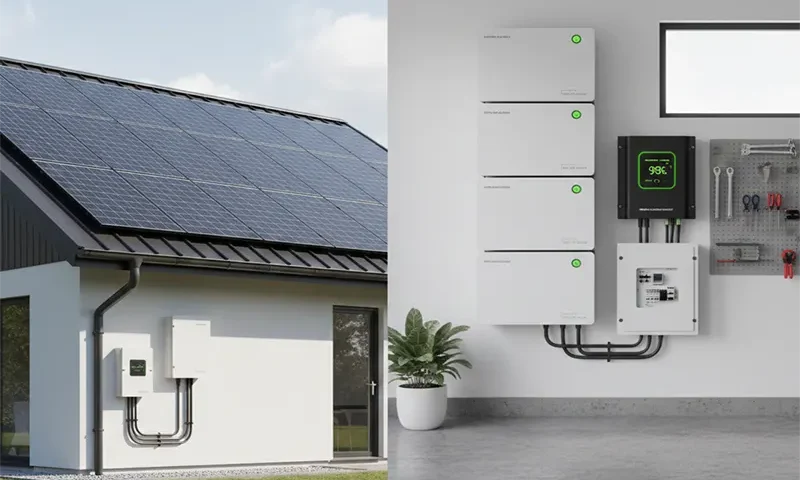
In 2026, the American energy landscape is undergoing a fundamental shift. Aging grid infrastructure, combined with the increasing frequency of extreme weather events, has moved residential energy storage from a “green luxury” to an essential component of home resilience. Homeowners are no longer satisfied with simple “partial backup”—the ability to keep a few lights and a refrigerator running. The modern standard is Energy Sovereignty: the capacity for a home to operate in Islanded Mode indefinitely, maintaining full lifestyle continuity regardless of grid status.
The Resilience Mandate: Energy vs. Power
To understand a whole-house backup system, one must first distinguish between two critical metrics: Energy (kWh) and Power (kW).
- Energy (Kilowatt-hours): This is the size of your “fuel tank.” A 20kWh battery can theoretically run a 1kW load for 20 hours. It determines how long you can stay off-grid.
- Power (Kilowatts): This is the “size of the pipe.” It determines how many appliances you can run simultaneously. If your battery only has a 5kW Continuous Power Output, you cannot run an electric clothes dryer (4kW) and a microwave (1.5kW) at the same time, even if the battery is 100% full.
For true whole-house resilience, a system must be sized to handle the home’s peak loads, not just its average consumption.
System Architectures: AC vs. DC Coupling
The way your batteries, solar panels, and home wiring interact is determined by the system architecture. In 2026, the industry is split between two primary configurations.
1. DC-Coupled Systems (The Efficiency Leader)
In a DC-coupled system, the electricity from your solar panels stays in Direct Current (DC) form as it travels into the battery. It is only converted to Alternating Current (AC) when you use it in the house.
- Pros: Higher round-trip efficiency (90%+) because it avoids unnecessary conversions.
- Best For: New installations where the solar and battery are designed together.
2. AC-Coupled Systems (The Retrofit Standard)
In an AC-coupled system, solar power is converted to AC by the solar inverter, then converted back to DC to charge the battery.
- Pros: Easier to add to an existing solar array.
- Best For: Homeowners who already have “grid-tied” solar and want to add resilience without replacing their current inverter.
Key Specs Comparison: Power vs. Energy
| Feature | Low-Resilience System | Whole-House System (2026 Standard) |
| Capacity (Energy) | 5 – 10 kWh | 20 – 40+ kWh |
| Continuous Power | 3 – 5 kW | 10 – 15+ kW |
| Peak/Surge Power | 7 kW (10 sec) | 20+ kW (10 sec) |
| Chemistry | Lead-Acid / NMC | Lithium Iron Phosphate (LFP) |
| Typical Loads | Lights, Fridge, WiFi | HVAC, EV Charging, Well Pumps |
The Chemistry of 2026: The Rise of LFP
While early home batteries utilized Nickel Manganese Cobalt (NMC)—the same chemistry found in older EVs—the residential market has almost entirely shifted to Lithium Iron Phosphate (LFP).
LFP is the preferred choice for home resilience for three reasons:
- Safety: LFP is far more thermally stable than NMC, virtually eliminating the risk of “thermal runaway” or battery fires.
- Cycle Life: LFP batteries can often handle 6,000 to 10,000 cycles (roughly 15–20 years of daily use) before dropping to 80% capacity.
- Depth of Discharge (DoD): Modern LFP systems allow for 100% DoD, meaning you can use the entire battery capacity without damaging the cells.
Managing Heavy Loads: The “Inrush” Challenge
The biggest hurdle for a whole-house backup is the Inrush Current (or “locked rotor amps”). Large motors, such as those in central Air Conditioning units or well pumps, require a massive surge of power—often 3 to 5 times their running wattage—just to start up.
If your battery system cannot handle this millisecond-long surge, the system will trip and the house will go dark. In 2026, resilience engineers solve this through:
- Soft Starters: Small devices installed on A/C units that ramp up the motor slowly, reducing surge requirements by up to 70%.
- Smart Load Shedding: Intelligent panels that automatically disconnect non-essential loads (like the pool pump or EV charger) the moment the grid fails, preserving the “surge budget” for the A/C or heater.
Energy Arbitrage and Virtual Power Plants (VPPs)
A whole-house battery isn’t just an insurance policy; it’s a financial tool. Through Energy Arbitrage, the system’s “brain” (the Hybrid Inverter) manages your power based on Time-of-Use (TOU) rates.
- Charge: The battery fills up during the day from excess solar or at night when grid rates are lowest.
- Discharge: The battery powers the home during “Peak” hours (usually 4 PM to 9 PM) when grid electricity is most expensive.
Furthermore, many 2026 homeowners participate in Virtual Power Plants (VPPs). During periods of extreme grid stress, the utility company pays you a premium to “borrow” a small percentage of your battery’s stored energy. This allows the battery to pay for itself significantly faster while supporting community-wide grid stability.
Installation and Safety Compliance
Modern installations must adhere to strict safety codes, specifically NEC 2023/2026. These regulations mandate:
- Automatic Transfer Switches (ATS): To ensure that when the grid goes down, your home is physically disconnected from the street. This prevents “backfeeding,” which could be fatal to utility workers repairing the lines.
- Rapid Shutdown: The ability for first responders to instantly de-energize both the solar panels and the battery from a single external switch.
- Outdoor Mounting: Most jurisdictions now require high-capacity LFP batteries to be mounted on exterior walls or in fire-rated enclosures to maximize safety.
The Path to Energy Sovereignty
A whole-house solar battery backup system is more than a collection of hardware; it is a declaration of independence. By combining high-capacity LFP chemistry with Smart Load Management and Hybrid Inverters, homeowners can finally step away from the fragility of the central grid. Whether you are facing a multi-day blizzard, a heatwave-induced brownout, or a long-term infrastructure failure, a properly sized backup system ensures that your home remains a sanctuary. In 2026, the most resilient home is the one that generates, stores, and manages its own “fuel.”

