
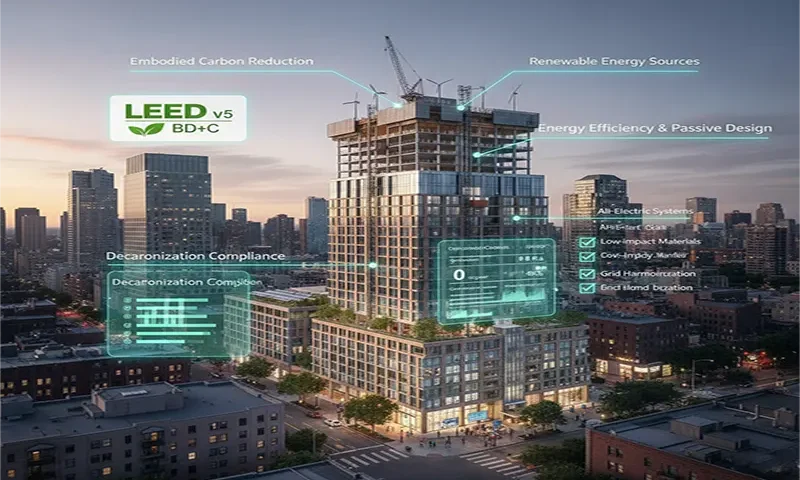
In 2026, the global real estate market has reached a critical juncture. No longer is “green building” defined simply by low-flow faucets or bike racks. With the official rollout of LEED v5, the U.S. Green Building Council (USGBC) has fundamentally recalibrated the world’s most widely used green building rating system to address the climate emergency. LEED v5 BD+C is no longer just a sustainability checklist; it is a rigorous decarbonization framework.
For the first time, Decarbonization accounts for 50% of the total available points in the system. This shift signals a transition from measuring “efficiency” to mandating “performance,” forcing project teams to account for every kilogram of carbon emitted from ground-break to the year 2050.
The 2026 Paradigm Shift: Impact-Driven Scoring
The traditional LEED categories have been reorganized under three core Impact Areas:
- Decarbonization (50%)
- Quality of Life (25%)
- Ecological Conservation (25%)
This restructuring means that a project can no longer achieve high-level certification by “point hunting” in minor categories. To succeed in LEED v5, a building must prove its ability to thrive in a low-carbon economy. The most transformative change is the move toward Whole-Life Carbon accounting, which unites operational energy use with the “buried” emissions of construction materials.
Operational Carbon: The 25-Year Emissions Roadmap
Under the new Integrative Process Prerequisite (IPp3), LEED v5 introduces a mandatory 25-year Operational Carbon Projection. Project teams are required to model the building’s emissions not just as a static “snapshot” at completion, but as a roadmap through 2050.
This roadmap must account for:
- Grid Decarbonization: Modeling how the local utility grid will shift toward renewables over the next quarter-century.
- On-site Combustion: A transparent accounting of any fossil fuels used on-site (though these are heavily penalized).
- Decarbonization Plan: Every project must submit a formal plan detailing how the building will eventually reach Net Zero emissions, including future retrofits for HVAC or energy storage.
Mandatory Decarbonization Prerequisites in LEED v5 BD+C
The barrier to entry for LEED v5 is significantly higher than v4. Several strategies that were once optional “credits” are now mandatory prerequisites.
| Prerequisite Code | Name | Core Requirement |
| IPp3 | Carbon Assessment | Model 25-year operational emissions + baseline embodied carbon. |
| EAp1 | Decarbonization Plan | A formal, documented strategy to reach Net Zero by 2050. |
| MRp2 | Embodied Carbon Quantification | Mandatory “Cradle-to-Gate” (A1–A3) LCA for structure and enclosure. |
| EAp2 | Energy Performance | Minimum efficiency baseline raised to ASHRAE 90.1-2022. |
The Embodied Carbon Revolution
While operational energy has always been a LEED staple, LEED v5 brings Embodied Carbon (the emissions from manufacturing, transporting, and installing materials) into the spotlight. Under MRp2, every BD+C project must conduct a Whole-Building Life Cycle Assessment (WBLCA).
The focus is on “The Big Hitters”—concrete, steel, and aluminum. Projects are now required to:
- Inventory: Use Environmental Product Declarations (EPDs) to quantify the Global Warming Potential (GWP) of the structure and enclosure.
- Reduce: Through the MRc2: Reduce Embodied Carbon credit, teams earn points for demonstrating a 10% to 20% reduction against a baseline.
- Procure: LEED v5 rewards “Low-Carbon Procurement,” favoring specific manufacturers who have successfully decarbonized their production lines.
Electrification and Grid Harmonization
In the Energy and Atmosphere (EA) category, the message is clear: The future is electric. The new Electrification Credit (EAc1) offers significant points for buildings that eliminate on-site combustion for space heating, water heating, and cooking.
However, being electric isn’t enough; the building must also be “Grid-Smart.” LEED v5 emphasizes Grid Harmonization, rewarding projects that include:
- Demand Flexibility: The ability to shed or shift loads during peak grid stress.
- Carbon-Responsive Control: Smart systems that draw more power when the grid is “cleanest” (high solar/wind) and throttle back when the grid is “dirty” (high gas/coal).
- Energy Storage: Using on-site batteries to support the local microgrid.
The “Platinum Ceiling”: Hard Thresholds for Leadership
In previous versions, you could reach Platinum by being exceptionally good at “General Sustainability.” In LEED v5, the USGBC has introduced Hard Thresholds for Platinum certification. To achieve the 80-point Platinum level, projects must meet these specific criteria:
- 100% Renewable Energy: All energy must be offset by Tier 1 or Tier 2 renewable sources.
- Fossil-Fuel-Free: Zero on-site combustion for standard building operations.
- 20% Embodied Carbon Reduction: A significant, proven decrease in material emissions compared to an industry baseline.
- Electrification: Full electrification of HVAC and domestic hot water systems.
Alignment with Global Standards
LEED v5 represents the alignment of the building industry with the Paris Agreement and the AIA 2030 Commitment. By mandating carbon assessments and long-term planning, it ensures that buildings designed today will not become “stranded assets” in a 2050 Net Zero world.
For developers and owners, compliance with LEED v5 is no longer just about a plaque on the wall; it is about future-proofing investments against rising carbon taxes and meeting the increasingly stringent ESG (Environmental, Social, and Governance) requirements of global investors.

