
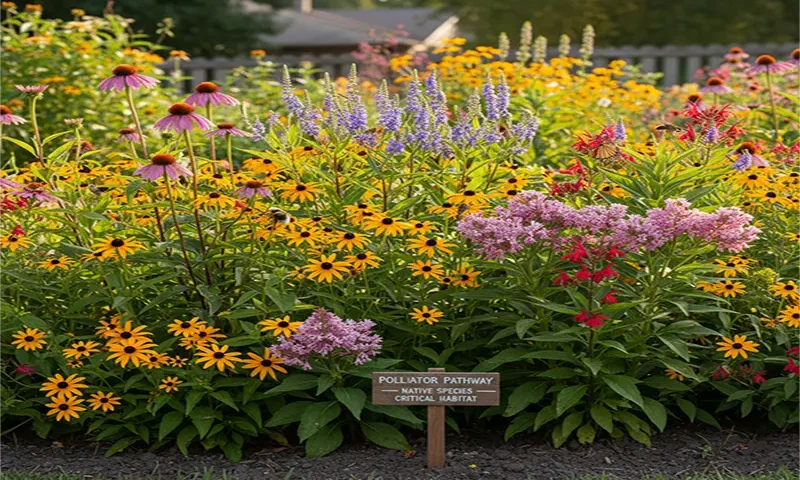
In the field of restoration ecology, the year 2026 has marked a definitive shift in how we view our backyard gardens. We have moved past the generic “save the bees” sentiment toward a more precise, data-driven approach: building functional pollinator pathways. The central pillar of this strategy is the use of keystone native plant species.
Just as the keystone in a Roman arch holds the entire structure together, these specific plants provide the essential foundation for our local food webs. Without them, the arch of biodiversity collapses.
The Keystone Concept: 14% Supporting 90%
The biological reality of our ecosystems is surprisingly lopsided. Research by entomologist Dr. Doug Tallamy and his colleagues has revealed a startling statistic: a mere 14% of native plant genera support 90% of the butterfly and moth species (Lepidoptera) that provide the critical protein (caterpillars) needed to feed birds and other wildlife.
In a pollinator pathway—a network of connected habitats across private and public lands—these keystone plants act as “high-volume fueling stations” and “nurseries.” If a pathway consists only of non-native ornamentals or low-impact native plants, it may offer nectar, but it fails to support the full life cycle of the insects that drive the ecosystem.
The Powerhouse Genera: Woody Plants (Trees and Shrubs)
If you have room for only one plant, it should be a tree. In 2026, the ecological community recognizes woody plants as the heavyweights of carbon sequestration and biodiversity.
- Oaks (Quercus): The undisputed champions. A single oak tree can host over 500 species of caterpillars. They are the ultimate “host plant,” providing more life-sustaining energy than any other genus in North America.
- Cherries and Plums (Prunus): These are the second-tier powerhouses, hosting roughly 450 species. Crucially, they bloom early in the spring, providing vital nectar for queen bumblebees as they emerge from hibernation.
- Willows (Salix): Willows are essential for specialist bees. In many regions, up to 14 species of bees can only feed their young on the specific pollen provided by native willows.
The Powerhouse Genera: Herbaceous Perennials
While trees provide the scale, herbaceous perennials provide the seasonal variety necessary to keep a pollinator pathway open from spring through the first frost.
- Goldenrods (Solidago): Often unfairly blamed for allergies (the real culprit is ragweed), goldenrods are the #1 perennial keystone. They support over 100 caterpillar species and dozens of specialist bees. In autumn, they provide the high-calorie “jet fuel” needed for the Monarch butterfly’s southward migration.
- Asters (Symphyotrichum): Flowering alongside goldenrods, asters provide the blue and purple spectrum of the “fall buffet.” They are critical for late-season specialist bees who require their pollen to finish their reproductive cycles.
- Native Sunflowers (Helianthus): These are not the giant agricultural mammoths, but rather the perennial woodland and prairie sunflowers. In the Western U.S., Helianthus species support more specialist bees than any other herbaceous genus.
Top 5 Keystone Genera for North American Ecoregions
| Plant Genus | Common Name | Role in Ecosystem | Specialist Support |
| Quercus | Oak | Primary Larval Host | High (500+ Lepidoptera) |
| Solidago | Goldenrod | Late-Season Fuel | High (40+ Specialist Bees) |
| Prunus | Native Cherry | Early Spring Nectar | High (450+ Lepidoptera) |
| Symphyotrichum | Aster | Fall Pollen | High (30+ Specialist Bees) |
| Helianthus | Sunflower | Summer/Fall Protein | High (50+ Specialist Bees) |
Beyond Nectar: Larval Hosts and Specialist Bees
The mistake of early 2000s “pollinator gardens” was a hyper-focus on nectar. Nectar is just sugar water—it’s the “soda” of the insect world. To build a pathway, we must provide larval host plants (protein for caterpillars) and specific pollen for specialist bees.
Specialist bees, or “oligoleges,” have co-evolved to collect pollen from only one or two plant families. If those specific plants (like Salix or Solidago) are missing from a neighborhood, those bee species simply vanish. A keystone-rich garden ensures that even the pickiest “eaters” in the ecosystem have a seat at the table.
Implementation Strategy: The 70/30 Rule and “Soft Landings”
To create a functional ecosystem, your landscape doesn’t need to be 100% native, but it must reach a critical mass.
- The 70/30 Rule: Research indicates that for bird populations to remain stable, a landscape must consist of at least 70% native plant biomass. This allows you to keep a few favorite non-invasive ornamentals while still supporting a breeding population of birds and insects.
- Soft Landings: This is a crucial 2026 design standard. Most caterpillars that feed on keystone trees don’t pupate in the branches; they drop to the ground to burrow into the soil or hide in leaf litter. If you have mown turf under your oak tree, it becomes a “trap crop”—the caterpillars grow there but die when they fall. A Soft Landing is a deliberate planting of native groundcovers (like Carex or Asarum) under the tree’s drip line to provide a safe, uncompacted place for insects to complete their life cycle.
- Avoid “Nativars”: Whenever possible, choose “straight species” over cultivars (e.g., Symphyotrichum laeve instead of a “Double Purple” variety). Many hybridized plants have altered leaf chemistry or flower shapes that make them unrecognizable or inaccessible to the very insects we are trying to save.
The Homegrown National Park
The future of North American biodiversity rests on the collective action of millions of small-scale gardeners. By selecting keystone species, we transform our yards from “ecological dead zones” into vital segments of a continental Pollinator Pathway. We are no longer just planting flowers; we are building a “Homegrown National Park,” one oak tree and one goldenrod at a time. This is the ultimate statement in 21st-century luxury: a garden that is not only beautiful to the eye but teeming with the vibrant, complex dance of life.

