
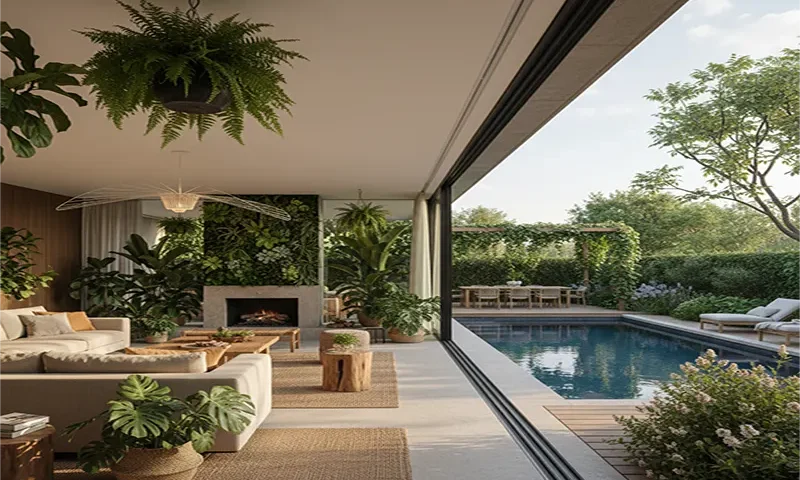
In 2026, the concept of a home has undergone a radical transformation. We have moved past the era of stark, “clinical” minimalism and entered the age of the Biological Sanctuary. Modern biophilic design is no longer just about adding a few potted plants to a room; it is an evidence-based architectural framework that treats the home as a living, breathing ecosystem. By weaving nature’s rhythms—light, texture, and organic geometry—into the very fabric of our dwellings, we are creating spaces that don’t just house us, but actively heal us.
The 2026 Biophilic Mandate: From “Decor” to “System”
The modern biophilic mandate is rooted in the psychological theory of Soft Fascination. Unlike the “hard fascination” required to navigate a digital screen or a busy city street, nature captures our attention effortlessly, allowing our directed attention reserves to replenish. In 2026, architects are using this to combat “digital fatigue” by designing homes that lower cortisol levels by up to 20% through constant, subtle sensory engagement with the natural world.
Blurring the Threshold: The Architectural “Dissolve”
The most defining feature of 2026 biophilic homes is the zero-threshold transition. This isn’t just a large window; it is a structural “dissolve” where the indoors and outdoors become a single continuous plane.
- Continuous Materiality: By using the same unfilled travertine or weathered oak for both the interior living room floor and the exterior garden terrace, the brain perceives no boundary.
- Internal Courtyards: Modern designs are increasingly “turning inward,” featuring glass-walled central courtyards or “living lanterns.” These internal gardens act as the home’s lungs, providing natural cross-ventilation and a private pocket of wilderness visible from every room.
- Framed Vistas: Windows are no longer just apertures; they are “landscape frames” positioned to capture a specific tree canopy or the movement of clouds, ensuring that even in high-density urban areas, the occupant is never disconnected from the horizon.
The 6 Core Elements of Biophilic Architecture
| Element | Description | 2026 Application |
| Environmental Features | Use of actual natural elements. | Integrated living walls and indoor water rills. |
| Natural Shapes & Forms | Avoiding right angles and hard edges. | Arched thresholds, curved islands, and sinuous sofas. |
| Natural Patterns | Using the math of nature (Fractals). | Wood grains, leaf-vein motifs, and stone veining. |
| Light & Space | Mimicking the sun’s natural cycles. | Circadian-synced LED systems and sun-tracking skylights. |
| Place-Based Relationships | Linking the home to its local geography. | Use of local clay, stone, and native plant species. |
| Human-Nature Evolution | Designing for “Prospect and Refuge.” | Cozy, recessed “sleeping niches” with wide-angle views. |
The “Post-Gray” Palette: Tactile Biophilia
We have officially moved into the “Post-Gray” era of interior design. The cold, industrial grays of the last decade have been replaced by a palette of Earthbound Serenity: terracotta, moss green, deep ochre, and warm walnut. However, the true luxury of 2026 lies in Tactile Biophilia.
Our brains are biologically wired to crave irregular, natural textures. Modern homes celebrate “Honest Materials” that age gracefully:
- Unpolished Stone: Travertine with its natural pores left open, or honed soapstone that feels like velvet to the touch.
- Charred Timber (Shou Sugi Ban): Used for both exterior cladding and interior accents, providing a rich, carbon-rich texture that is both sustainable and visually grounding.
- Limewash and Roman Clay: These breathable wall finishes mimic the movement of light across a cliff face, providing a depth and “softness” that flat paint cannot achieve.
Invisible Integration: Smart Biological Systems
The most advanced biophilic homes use technology to support biology, not replace it. Two key systems have become standard in 2026 luxury builds:
1. Circadian Lighting
Using RGBTW (Red, Green, Blue, Tunable White) LED technology, modern lighting systems automatically shift color temperature and intensity to mimic the sun. In the morning, the home is bathed in blue-rich light to boost alertness; by evening, it transitions to a warm, near-infrared glow that facilitates melatonin production. This “Human-Centric Lighting” ensures that even if you spend your day indoors, your internal clock remains synced with the planet.
2. Integrated Living Walls
No longer just a decorative feature, integrated living walls are now hooked into the home’s HVAC system. These vertical ecosystems act as bio-filters, with the roots of the plants scrubbing the air of VOCs (volatile organic compounds) and naturally regulating humidity. They serve as “visual fractal generators,” providing the complex, repeating patterns that our eyes find inherently relaxing.
The Fractal Aesthetic: Softening the Modern Edge
Nature is rarely linear. To reduce neurological stress, modern biophilic design embraces Biomorphic Forms. Arched doorways, elliptical kitchen islands, and “pebble-shaped” furniture remove the “threat” response our brains sometimes feel in sharp-edged, boxy environments. This shift toward “soft minimalism” creates a sense of flow and safety, encouraging Prospect and Refuge—the ability to feel protected (refuge) while still having a clear view of the surroundings (prospect).
Sustainable Luxury: The Regenerative Home
Biophilic design is the natural partner of sustainability. In 2026, luxury is defined by a building’s ability to be regenerative.
- Water Management: Indoor water rills aren’t just for sound; they are often part of a graywater filtration system that feeds the indoor garden.
- Phytoncides: By selecting specific woods like cedar or hinoki, designers introduce phytoncides—natural oils released by trees—into the home’s air, which have been proven to boost the human immune system.
The Home as a Healing Sanctuary
As our lives become increasingly digital and urbanized, the home must serve as a counterbalance. Modern biophilic design is the ultimate antidote to “nature deficit disorder.” It is a move away from the home as a “machine for living” and toward the home as a vessel for life. By prioritizing natural light, tactile materials, and organic forms, we aren’t just building houses; we are creating healing sanctuaries that reconnect us to our ancestral roots while looking firmly toward a sustainable future.

