
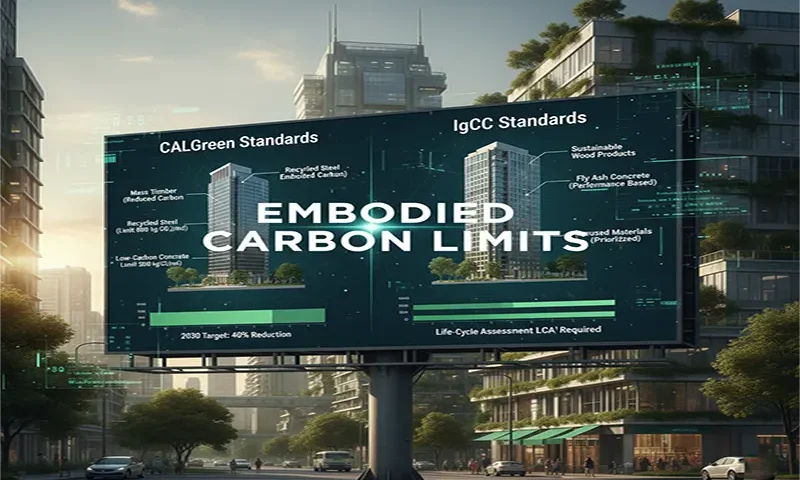
As of January 1, 2026, the landscape of commercial construction in California and across the United States has shifted. The focus of sustainable design, once dominated by operational energy (the power used to light and heat a building), has turned toward Embodied Carbon—the greenhouse gas emissions “locked in” during the extraction, manufacturing, and transportation of building materials.
In California, the mandatory 2026 updates to CALGreen (Title 24, Part 11) represent the most aggressive decarbonization policy in the nation, lowering the compliance threshold to include almost all mid-sized commercial developments. Simultaneously, the International Green Construction Code (IgCC) provides the national framework for jurisdictions outside of California to adopt similar high-performance standards.
The Regulatory Landscape: The 2026 Mandate
Effective January 1, 2026, California mandates that all new non-residential construction projects (and additions/alterations) exceeding 50,000 square feet must comply with embodied carbon reduction measures. This is a significant drop from the 2024 threshold of 100,000 square feet, signaling that carbon accounting is no longer a niche requirement for “mega-projects” but a standard part of the permitting process.
These limits target Upfront Carbon (Life Cycle Stages A1–A3), which typically accounts for over 50% of a new building’s total carbon footprint over a 30-year span.
The Three Pathways to CALGreen Compliance
Architects and developers can choose one of three distinct adventures to meet the 2026 requirements.
1. Building Reuse (The Circular Path)
The most direct way to save carbon is to not build new. This pathway requires maintaining at least 45% of the existing building’s primary structural elements (foundations, columns, beams, walls) and the building enclosure. This path is favored for urban infill and adaptive reuse projects where the “carbon debt” of the original structure has already been paid.
2. Performance Path (Whole Building LCA)
Using specialized software (such as One Click LCA or Tally), the design team conducts a cradle-to-grave Whole Building Life Cycle Assessment (WBLCA). To comply, the proposed design must demonstrate a 10% lower Global Warming Potential (GWP) than a baseline building of similar size and function. This allows for “carbon trade-offs”—for example, using a more carbon-intensive steel frame but offsetting it with carbon-sequestering mass timber or ultra-low-carbon concrete.
3. Prescriptive Path (The EPD Verification)
For projects not conducting a full LCA, the prescriptive path focuses on individual high-impact materials. Each covered material must have a third-party verified Environmental Product Declaration (EPD) showing a GWP value below the state-set limits.
CALGreen Mandatory GWP Limits for Covered Materials
The limits are generally set at 175% of the industry average, ensuring that only the most carbon-intensive “bottom-tier” products are excluded, while pushing the market toward transparency.
| Eligible Material | Functional Unit | Max GWP Limit (Mandatory) |
| Hot-Rolled Structural Steel | 1 metric ton | 1,010 kg $CO_2e$ |
| Concrete Reinforcing Steel | 1 metric ton | 890 kg $CO_2e$ |
| Flat Glass | 1 metric ton | 1,430 kg $CO_2e$ |
| Light-Density Mineral Wool | 1 $m^2$ (RSI=1) | 3.33 kg $CO_2e$ |
| Ready-Mix Concrete | 1 $m^3$ | Varies by strength (PSI) |
Note: GWP limits for concrete are regionally specific and scale with compressive strength.
IgCC and ASHRAE 189.1 Integration
While CALGreen leads in California, the 2024 International Green Construction Code (IgCC)—powered by ASHRAE Standard 189.1—serves as the model for “reach codes” nationwide.
The IgCC provides a “Jurisdictional Options” table, allowing local governments in states like Colorado, Washington, and New York to adopt specific embodied carbon “tiers.” Unlike CALGreen’s current broad limits, the IgCC often encourages a more holistic view of material life cycles, including Stage B (maintenance) and Stage C (end-of-life), pushing designers toward Circular Design—the ability for a building to be disassembled and its materials reused in 2086.
Implementation: EPDs and Digital Tracking
The “nutrition label” of the construction world is the Environmental Product Declaration (EPD). In 2026, procurement teams must treat GWP values with the same scrutiny as cost and lead times.
- Cradle-to-Gate Scope: Limits typically focus on modules A1 (extraction), A2 (transport), and A3 (manufacturing).
- Digital Verification: Tools like the EC3 (Embodied Carbon in Construction Calculator) allow specifiers to compare local EPDs in real-time. Code officials now require these digital reports as part of the submittal package to prove that the steel or concrete arriving at the site matches the “low-carbon” specs promised in the design phase.
The Road to 2035: AB 2446
The 2026 code is merely the foundation. Under California Assembly Bill 2446, the state is required to develop a strategy to achieve a 40% net reduction in embodied carbon by 2035. This will likely involve:
- Expanding “covered materials” to include aluminum, wood structural elements, and gypsum board.
- Lowering GWP thresholds from 175% toward 100% of the industry average (CALGreen Tier 2 standards).
- Establishing a baseline for residential construction, which is currently exempt under CALGreen’s non-residential mandate.
The New “Energy Code”
Embodied carbon limits represent the most significant change to the building code since the introduction of energy modeling in the 1970s. For the modern developer, understanding GWP thresholds is no longer optional—it is a prerequisite for a permit. By aligning CALGreen mandates with IgCC frameworks, the industry is finally addressing the “upfront” half of the climate equation, ensuring that the buildings of 2026 are truly sustainable from the moment the first column is raised.

