
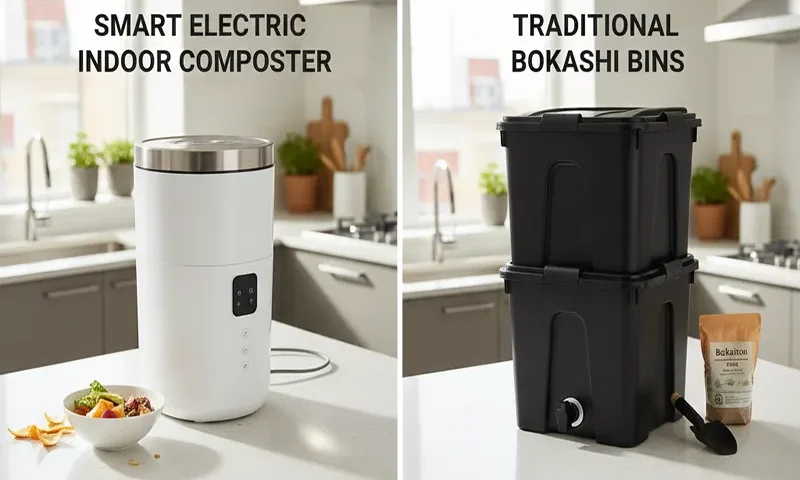
Living in a high-rise apartment in 2026 brings many perks—city views, proximity to work, and a smaller carbon footprint. However, it also presents a persistent, smelly dilemma: food waste. If you’re someone who cringes at the thought of tossing organic scraps into a plastic trash bag to rot in a landfill, you’ve likely looked into indoor composting.
The market has split into two warring factions. On one side, we have the Smart Electric Composter—the sleek, high-tech “bioreactor” that looks like a high-end espresso machine. On the other, we have the Traditional Bokashi Bin—a low-tech, Japanese-inspired fermentation system that has been the darling of eco-minimalists for decades.
Which one actually belongs in your kitchen? Let’s break down the tech, the smell, and the “dirty” reality of both.
The Contenders: High-Tech Grinding vs. Ancient Fermentation
Before we dive into the comparison, we must define what these systems actually do to your banana peels.
1. The Smart Electric Composter (The Dehydrator/Bioreactor)
Modern 2026 models like the Lomi 2.0, Mill, or GEME are marvels of engineering. They use a combination of heat, powerful grinding blades, and sometimes specialized microbial additives to break down food waste. In a matter of 4 to 24 hours, these machines reduce the volume of your waste by up to 90%, leaving you with a dry, soil-like material.
2. The Traditional Bokashi Bin (The Anaerobic Fermenter)
Bokashi isn’t technically composting; it’s “pickling.” You layer your food scraps in an airtight bucket with “Bokashi bran”—a substrate inoculated with Effective Microorganisms (EM). Because the process is anaerobic (oxygen-free), the food ferments rather than rots. After two weeks of being sealed away, your scraps look mostly the same but have been chemically transformed.
Operational Deep Dive: How Much Work Is It?
Electric: The “Set It and Forget It” Dream
The primary appeal of the electric composter is its “magic” factor. You dump in your leftovers (including meat and dairy in many models), press a button, and walk away. By morning, your dinner scraps are a handful of odorless granules.
- The 2026 Edge: Many new models are now app-integrated, tracking your carbon diversion stats and notifying you when the carbon filters need a swap.
Bokashi: The Art of the Layer
Bokashi requires a more “hands-on” relationship with your waste. Every time you add scraps, you must mash them down to remove air pockets and sprinkle a fresh layer of bran.
- The “Tea” Factor: Every few days, you must use a spigot at the bottom of the bin to drain “Bokashi tea”—a nutrient-rich but incredibly pungent liquid. If you forget to drain it, the whole system can go sour.
Quick Comparison Table: At a Glance
| Feature | Smart Electric Composter | Traditional Bokashi Bin |
| Processing Speed | 4–24 Hours | 2–4 Weeks |
| Upfront Cost | High ($300–$600) | Low ($40–$80) |
| Ongoing Cost | Filters & Electricity | Bokashi Bran/Grain |
| Odors | Minimal (Carbon Filtered) | Fermented/Vinegary (Airtight) |
| Effort Level | Low (Automatic) | Moderate (Manual) |
| Accepted Foods | Most (incl. small bones) | All (incl. meat/dairy) |
The “Output” Reality Check: Where Does It Go?
This is where many apartment dwellers get caught off guard. Neither system produces finished “potting soil” instantly.
The Electric Output: What comes out of an electric composter is essentially “dehydrated food.” While it looks like dirt, it hasn’t fully decomposed. If you put it directly into a small indoor pot, it can mold as it rehydrates. It is best used as a “soil enhancer” or sent to a municipal composting program that accepts processed organics.
The Bokashi Output: This is even trickier for apartment life. When you open your Bokashi bin after two weeks, you are greeted with “pickled” food that is highly acidic. You cannot put this on a houseplant; it will kill it. To finish the process, you must “trench” the waste (bury it in soil) for another two weeks. For an apartment dweller, this usually means having a secondary “soil factory”—a large plastic tub of dirt on the balcony where the pickled waste can finish its transformation.
User Experience: Odors and Pests
In an apartment, a fruit fly outbreak is a catastrophe.
- Electric: These units are generally the winners here. Because they dry the food out so quickly, there is no moisture to attract flies. Heavy-duty activated carbon filters neutralize the “cooked vegetable” smell that can occur during the heating cycle.
- Bokashi: As long as the lid is airtight, there is no smell. However, the moment you open the lid to add scraps, you are hit with a strong, vinegary, fermented odor. Some people find it pleasant; others find it nauseating. If the seal fails, or if you don’t use enough bran, it can quickly transition from “pickled” to “putrid.”
Sustainability & Cost Analysis
The Electric Compactor has a high “embodied carbon” footprint. You are buying a complex appliance made of plastic, metal, and circuit boards. It also draws electricity (though 2026 models are incredibly efficient, often costing less than $2/month). The convenience comes at a literal price: $400+ upfront.
The Bokashi Bin is incredibly low-tech and can even be DIY-ed with two 5-gallon buckets. The only recurring cost is the bran. However, you must consider the “transportation cost” of your effort. If you end up throwing the Bokashi waste in the trash because you don’t have a place to bury it, you’ve essentially just pickled your trash before it hits the landfill—defeating much of the purpose.
The Verdict: Which is Best for You?
Choose the Smart Electric Composter if:
- You have a high budget and a busy lifestyle.
- You have zero tolerance for “fermentation” smells or manual labor.
- Your primary goal is volume reduction so you only have to take the “trash” out once every two weeks.
- You have access to a green bin program or a local community garden that accepts pre-processed food.
Choose the Traditional Bokashi Bin if:
- You are on a budget and love the science of microbes.
- You have a balcony or a “soil factory” tub to finish the composting process.
- You want a system that uses zero electricity and has no mechanical parts to break.
- You have high-need plants that would benefit from the “Bokashi tea” fertilizer.
Final Thoughts: The Path to Zero Waste
In 2026, the best system is the one you will actually use. If a Bokashi bin sits in your pantry as a “bucket of guilt” that you’re too afraid to open, it’s not helping the planet. Conversely, if you enjoy the high-tech feedback of an app-controlled composter, that $500 investment might be the catalyst that finally keeps your food waste out of the landfill.
Both systems are valid, but they serve different “eco-personalities.” One is a kitchen appliance; the other is a biological partnership. Choose wisely, and your nose (and the planet) will thank you.

