
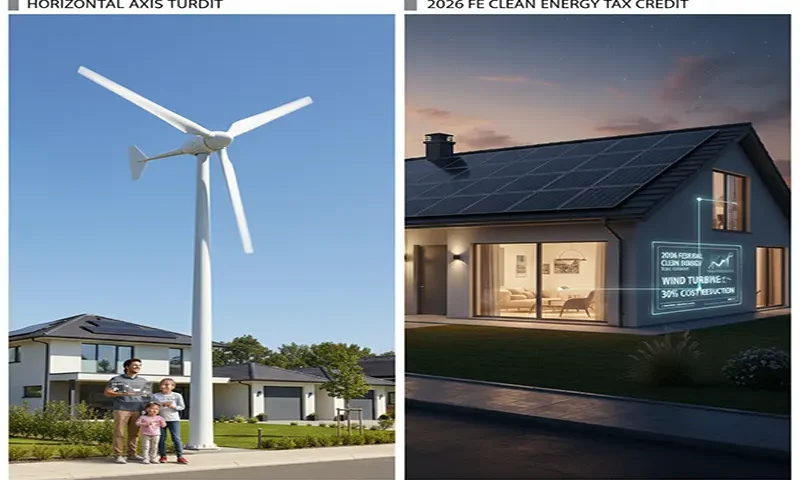
As of February 2026, the landscape for residential renewable energy has undergone a significant transformation. Following the enactment of the One Big Beautiful Bill (OBBB) Act in July 2025, the generous pathways established by the Inflation Reduction Act (IRA) have been narrowed. While the 30% Residential Clean Energy Credit (Section 25D) technically remains the headline rate, the 2026 requirements introduce rigorous new “Physical Work” tests and domestic content hurdles that did not exist two years ago.
For homeowners, 2026 is a “use it or lose it” year. Navigating these new federal mandates is no longer just about buying a turbine; it is about proving a timeline of significant on-site construction and verified domestic sourcing.
The 2026 Policy Pivot: BOC and Termination Dates
The most critical change in 2026 is the implementation of the “Beginning of Construction” (BOC) deadline. Under the OBBB Act and subsequent Treasury Notice 2025-42, wind projects are treated with greater scrutiny than residential solar.
- The July 4, 2026 Deadline: To qualify for the full 30% credit, construction must “officially” begin before July 5, 2026.
- The Placed-in-Service Trap: If your construction begins after this date, the project must be fully operational—meaning “placed in service”—by December 31, 2027. If the project misses this window, it may lose eligibility for federal credits entirely under the OBBB’s termination provisions.
The Physical Work Test: The New Gatekeeper
Previously, homeowners could rely on a “Safe Harbor” by spending 5% of the project cost to “begin” construction. In 2026, the IRS has largely eliminated this for wind energy. You must now pass the Physical Work Test, proving that work of a “significant nature” has occurred on-site.
Qualifying Physical Work includes:
- Excavation for the turbine foundation.
- The pouring of concrete pads or setting of anchor bolts.
- The installation of the tower or the turbine nacelle.
Non-Qualifying Activities:
- Site clearing or test drilling.
- Environmental studies or permitting.
- Purchasing equipment that sits in a warehouse (inventory).
Equipment Certification and Performance Standards
The IRS only allows credits for “Qualified Small Wind Energy Property.” In 2026, the definition of “qualified” is strictly tied to third-party safety and performance metrics. To claim the credit on your taxes, the turbine must be certified to meet one of the following standards:
- ANSI/ACP 101-1: The American Clean Power Association standard for small wind.
- IEC 61400 Series: The International Electrotechnical Commission standards for mechanical and structural safety.
The turbine must also have a nameplate capacity of 100 kW or less to qualify as a “small wind” residential asset. Larger systems fall under commercial codes (Section 48E), which carry even more complex prevailing wage requirements.
Domestic Content: The 40% Gatekeeper
A major pillar of the 2025/2026 regulatory shift is the Material Assistance Test. For any project beginning construction in 2026, a specific percentage of the total project value must be derived from domestic (U.S.) components.
- The 40% Threshold: At least 40% of the cost of the turbine components (including the nacelle, blades, and tower) must be manufactured in the U.S., Mexico, or Canada.
- Prohibited Foreign Entities (FEOC): As of January 1, 2026, any project containing critical minerals or battery components sourced from “prohibited foreign entities” is ineligible for the credit, regardless of where the final assembly occurred.
Financial Mechanics: Claiming the 30% Credit
The 2026 tax credit is calculated as follows:
$$Tax\ Credit = 0.30 \times (Equipment\ Cost + Installation\ Cost)$$
Using IRS Form 5695
Homeowners must file IRS Form 5695 (Residential Clean Energy Credit).
- Line 3: This is specifically designated for “Qualified small wind energy property costs.”
- Carryforward: If the 30% credit is larger than the total federal tax you owe for 2026, the remaining balance can be “carried forward” to reduce your taxes in 2027.
Summary Timeline: 2026–2027 Deadlines
| Milestone | Date | Significance |
| BOC Deadline | July 4, 2026 | Physical work must be documented before this date to lock in eligibility. |
| Material Assistance Lock | Jan 1, 2026 | New FEOC restrictions on components apply to all projects starting this year. |
| Placed-in-Service Cutoff | Dec 31, 2027 | Final deadline for project completion for those starting after July 4, 2026. |
The Window of Opportunity
The era of “easy” green energy subsidization is closing. For the modern homeowner, the 2026 Federal Wind Tax Credit is a high-reward but high-compliance opportunity. By ensuring your project meets the ACP/IEC certification, passes the Physical Work Test before July, and utilizes domestic content, you can still secure a 30% reduction in your energy independence investment.

