
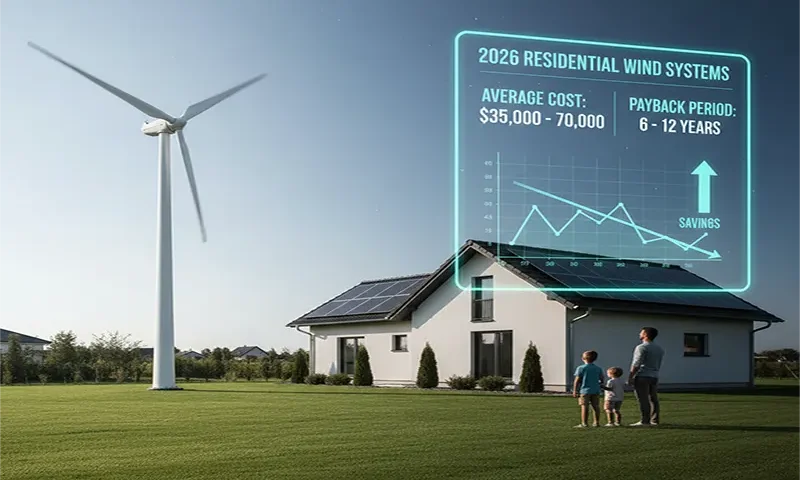
For the rural homeowner in 2026, energy independence has taken on a new level of urgency. As utility rates continue to climb and the power grid faces increasing strain from extreme weather, “Distributed Wind”—small-scale turbines designed for individual properties—has emerged as a powerful, albeit complex, alternative to solar.
However, the financial landscape has shifted. With the expiration of the Residential Clean Energy Credit (Section 25D) on December 31, 2025, the “30% off” era has ended. Today’s wind investments are no longer subsidized by federal tax appetites; they must stand on their own mechanical and meteorological merit.
1. The 2026 Cost Reality: Beyond the Turbine
In 2026, the average cost to install a residential wind system ranges from $3,000 to $8,000 per kilowatt (kW) of capacity. For a standard 5kW system—enough to offset a significant portion of an average American home’s usage—homeowners should budget between $30,000 and $45,000.
It is a common misconception that the turbine is the primary expense. In reality, the “invisible” infrastructure often carries the heaviest price tag:
- The Turbine & Generator (40%): The actual nacelle and blades.
- The Tower & Foundation (30%): In 2026, steel and concrete costs remain high. A 30-meter (100-foot) tower requires a massive concrete ballast to withstand storm-force winds.
- Electrical & Interconnection (15%): Inverters, heavy-gauge wiring, and utility-required shut-off switches.
- Permitting & Labor (15%): Zoning boards in 2026 are stricter regarding height and “flicker” effects, often requiring professional acoustic and environmental impact assessments.
2. The Physics of Payback: Why Height is Non-Negotiable
The single biggest mistake homeowners make is mounting a turbine too low. Wind power follows the Cube Law, which means that a small increase in wind speed leads to a massive increase in power output.
The power available in the wind ($P$) is calculated as:
$$P = \frac{1}{2} \rho A v^3$$
Where:
- $\rho$ is air density.
- $A$ is the swept area of the blades.
- $v$ is the wind speed.
Because power is proportional to the cube of the velocity ($v^3$), doubling the wind speed from $10\text{ mph}$ to $20\text{ mph}$ results in eight times the power. Since wind speed increases significantly with height (away from the friction of trees and buildings), a 100-foot tower will almost always pay for itself, while a 30-foot tower will likely never break even.
3. Calculating the 2026 Payback Period
Without the 30% federal tax credit, the average payback period for a residential wind system in 2026 has stretched to 12 to 20 years.
Factors That Shorten Payback:
- High Local Utility Rates: If your utility charges $>\$0.22/kWh$, wind becomes competitive much faster.
- The 12-mph Threshold: Systems in areas with average annual wind speeds below $12\text{ mph}$ ($5.4\text{ m/s}$) are rarely financially viable.
- Net Metering: If your state allows you to sell excess power back at the full retail rate, your “revenue” increases significantly.
The Maintenance Tax
Unlike solar panels, turbines have high-speed moving parts. Homeowners must factor in Annual Operations & Maintenance (O&M) costs. In 2026, expect to pay $40 to $100 per kW per year for professional inspections, bearing lubrication, and blade leading-edge repairs.
4. Residential Wind Investment Matrix (2026)
| Metric | 5kW Wind System (Tower-Mounted) | 5kW Solar Array (Roof-Mounted) |
| Installed Cost | $30,000 – $45,000 | $12,000 – $18,000 |
| Capacity Factor | 15% – 30% (Wind dependent) | 15% – 25% (Climate dependent) |
| Maintenance | Moderate (Moving parts/Climbing) | Low (Cleaning only) |
| Lifespan | 20 – 25 Years | 25 – 30 Years |
| Payback Period | 12 – 20 Years | 7 – 10 Years |
5. The Ideal Candidate for 2026
Given the high capital costs and the loss of tax incentives, wind energy in 2026 is a “niche” solution. You are an ideal candidate if:
- You have acreage: Most local ordinances require “fall-zone” clearances, meaning you need at least 1+ acre.
- You have high night-time usage: Unlike solar, wind often peaks at night and during stormy winter months when energy demand for heating is highest.
- You are off-grid: For those away from the wires, the $LCOE$ (Levelized Cost of Energy) of wind is often cheaper than running a diesel generator.
$$LCOE = \frac{\text{Initial Capital} + \text{Lifetime Maintenance}}{\text{Total Lifetime kWh Produced}}$$
Strategic Independence
In 2026, residential wind energy is less of a “get rich quick” scheme and more of a “fortress” strategy. While the payback period is longer than solar, a well-sited turbine provides a diversified energy portfolio. It generates power when the sun doesn’t shine—during the winter gales and the middle of the night—offering a level of resilience that solar alone cannot match. For the rural homeowner, the wind isn’t just weather; it’s a harvested resource.

