
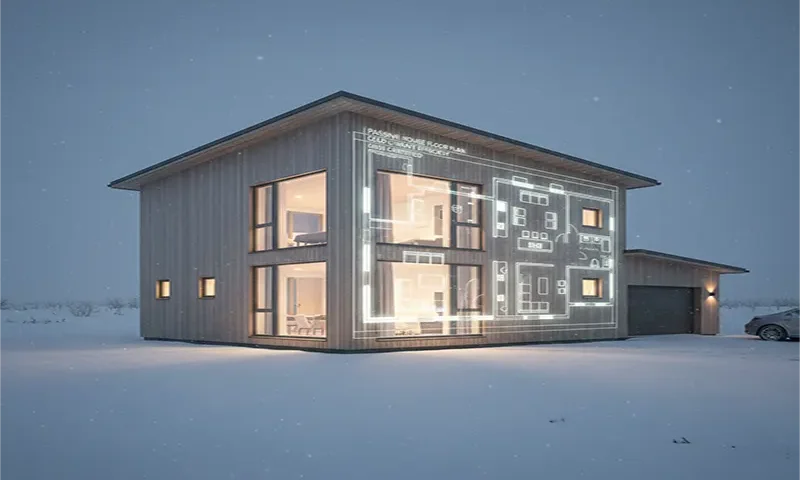
In the architectural landscape of 2026, the definition of a “home” has shifted. As climate volatility introduces more frequent and severe polar vortices, the Passive House standard has graduated from a niche environmental goal to a critical blueprint for absolute resilience. In cold climates, a modern floor plan is no longer just about aesthetics; it is a thermal strategy—a “Fortress of Warmth” designed to maintain habitable temperatures for weeks, even during total grid failure.
The 2026 Passive House—certified by the Passive House Institute (PHI) or Phius—utilizes the latest in vacuum insulation, bio-based structural cores, and AI-driven thermal orchestration to achieve a 90% reduction in heating energy compared to legacy building stock.
1. The Anatomy of a Cold-Climate Envelope
To survive sub-zero winters, the building envelope must transition from a “skin” to a high-performance “shield.”
Super-Insulation & The CLT Revolution
Traditional stick-framing is being replaced by Cross-Laminated Timber (CLT). CLT acts as both structure and thermal mass, sequestering carbon while providing a continuous surface that eliminates thermal bridges. In 2026, these cores are augmented with Vacuum Insulation Panels (VIPs), which offer R-values up to $R\text{–}40$ in just one inch of thickness.
Quad-Pane Glazing: The New Standard
Triple-pane windows were once the gold standard; today, cold-climate Passive Houses utilize Quad-pane, krypton-filled units. These windows feature a U-value as low as $0.60\ W/m^2K$, ensuring that the interior glass surface remains warm to the touch even when it is $-20^\circ C$ outside.
2. Floor Plan Strategy: The ‘Compact Volume’ Philosophy
In cold climates, geometry is destiny. The most efficient Passive House floor plans prioritize a low Surface-to-Volume (S/V) ratio.
The Mathematical Advantage
The rate of heat loss ($q$) is directly proportional to the surface area ($A$) through which heat can escape relative to the heated volume ($V$):
$$q \propto \frac{A}{V}$$
A cube or a compact rectangle is inherently more efficient than a sprawling, L-shaped floor plan because it minimizes the “exposure” of the interior to the external cold.
Zonal Thermal Buffering
Modern 2026 floor plans employ Thermal Zonation.
- The North Buffer: Storage rooms, mudrooms, pantries, and technical cores (housing the MVHR unit) are clustered on the north-facing wall. These act as “sacrificial” spaces that insulate the primary living areas.
- The South Aperture: Living rooms and kitchens are oriented toward the south, utilizing a Window-to-Wall Ratio (WWR) of roughly $30\text{–}40\%$ to maximize passive solar gain during the low-angle winter sun.
3. Mechanical Systems: The Lungs of the House
In an airtight envelope ($< 0.6\ ACH_{50}$), mechanical ventilation is the heartbeat of the home.
Sub-Soil Geothermal HRV
2026 designs frequently integrate Heat Recovery Ventilators (HRVs) with a sub-soil heat exchanger. Before outdoor air enters the house, it travels through a pipe buried 6 feet underground. The earth’s constant $10^\circ C$ temperature “pre-heats” the freezing intake air, preventing the HRV core from frosting and significantly reducing the load on the backup heating system.
AI Thermal Orchestration
The “smart home” has evolved into an Energy Orchestrator. 2026 systems use predictive AI to analyze 48-hour weather forecasts. If a blizzard is predicted, the AI preemptively increases the thermal “charge” of the home’s floors (via heat pumps) during off-peak hours, ensuring the structure remains warm through the storm.
4. Technical Comparison: Passive vs. Conventional
| Feature | Conventional Code (2026) | Passive House (Cold Climate) |
| Airtightness | $3.0\ ACH_{50}$ | $\leq 0.6\ ACH_{50}$ |
| Wall Insulation | $R\text{–}20$ to $R\text{–}30$ | $R\text{–}60$ to $R\text{–}100$ |
| Glazing | Double/Triple Pane | Quad-Pane (Krypton) |
| Heating Demand | $120\ kWh/m^2a$ | $\leq 15\ kWh/m^2a$ |
| Fresh Air | Natural Leaks/Exhaust Fans | Continuous Balanced HRV/ERV |
5. Case Study Archetype: The ‘Modern Homestead’
Imagine a 2,200 sq. ft. contemporary Passive House in Minnesota or Quebec.
- The Core: A central masonry heater (thermal mass) that radiates heat for 12 hours after a single small burn.
- The Layout: An open-plan ground floor with $12\text{–}foot$ ceilings to allow solar light to penetrate deep into the northernmost corners.
- The Mudroom: A high-performance airlock entrance that prevents the “chimney effect” of cold air rushing in when the door opens.
Efficiency as the Ultimate Luxury
In 2026, luxury is no longer defined by square footage, but by autonomy. A contemporary Passive House offers a silent, draft-free, and dust-free environment where the heating bill is an afterthought and the grid is a secondary concern. By designing for cold-climate efficiency, we aren’t just building houses; we are building resilient legacies that can withstand the tests of a changing world.

