
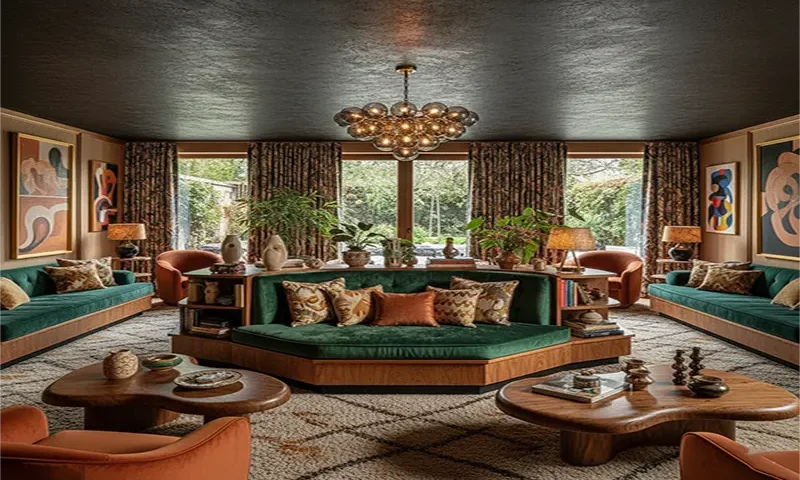
In the design landscape of 2026, we are witnessing a decisive departure from the sterile, hushed tones of “sad beige” minimalism. In its place, a vibrant, soulful, and deeply tactile movement has emerged: Modern Maximalism. This isn’t about clutter; it is about the deliberate curation of abundance. It is a style that favors “more is more,” provided that “more” is high-quality, historically resonant, and unapologetically comfortable.
At the epicenter of this resurgence are two icons of 1970s opulence: the sunken conversation pit and the swirling, organic complexity of burlwood. Together, these elements transform the living room from a mere passageway into a cinematic sanctuary built for intimate human connection.
The Conversation Pit: Lowering the Standard, Elevating the Style
The conversation pit is the ultimate architectural “hug.” Originally popularized in the mid-century and perfected in the 1970s, it removes the hierarchy of traditional furniture arrangements by creating a dedicated, sunken environment for dialogue.
Architectural Integration
In a modern context, you don’t necessarily need to jackhammer your foundation to achieve this look.
- The Built-In Pit: For those in the midst of a renovation, a permanent sunken section creates a powerful “room within a room” effect.
- The Modular Illusion: For existing spaces, the “modular pit” is the 2026 solution. Large, low-slung, U-shaped sectional sofas (like the iconic Roche Bobois Mah Jong or Mario Bellini Camaleonda) are placed on a slightly elevated platform, creating the psychological and physical sensation of descending into a private cove.
Textural Play: Velvet and Bouclé
Maximalism demands textures that catch the light. A conversation pit upholstered in deep-pile jewel-toned velvet—think emerald, sapphire, or a rich crushed amethyst—creates a sense of palatial depth. To modernize the look, designers are layering in bouclé pillows and shearling throws, adding a cozy, nubby contrast to the smooth sheen of the velvet.
Lighting the Depths
Lighting a conversation pit is an exercise in mood alchemy. Avoid overhead glare. Instead, utilize recessed LED strip lighting along the inner rim of the pit to create a hovering, ethereal glow. Complement this with a sculptural floor lamp (like an oversized Arco) that arches over the space, casting a warm, concentrated pool of light on the center.
Burlwood Accents: Organic Opulence
If velvet is the skin of the modern maximalist room, burlwood is its jewelry. Burlwood is harvested from tree growths where the grain has grown in a deformed, knotted, and swirling manner. The result is a chaotic, marble-like pattern that feels both ancient and futuristic.
The Statement Coffee Table
A conversation pit needs a centerpiece, and nothing commands attention like a large, low-slung burlwood slab. Whether it is a vintage 70s Milo Baughman piece or a contemporary live-edge cut, the golden-honey tones of the burl provide a warm, organic counterbalance to the saturated colors of the seating.
Strategic Burlwood Placement
- Architectural Elements: Consider burlwood wall panels or built-in shelving units. The intense pattern of the wood acts as a “natural wallpaper.”
- The Bar Cart: A burlwood bar cart tucked into a corner, stocked with smoked glassware and brass decanters, adds a touch of Studio 54-era glamour.
- Small Sculptural Touches: If a large piece feels too heavy, incorporate the texture through burlwood pedestals, heavy bookends, or decorative trays.
Color Palettes & Pattern Play: Controlled Chaos
Modern Maximalism thrives on the tension between different colors and eras. The goal is to create a space that feels like it was “collected over time,” even if it was designed in a week.
Deep, Saturated Hues
Start with a base of moody, “earth-adjacent” colors. Deep olive, terracotta, and burnt orange provide a 70s foundation, but they should be accented with modern neon-pastels or deep navy to keep the space from feeling like a time capsule.
Layered Patterns
Don’t be afraid to mix scales. A large-scale geometric rug (a nod to Verner Panton) can live harmoniously with animal-print throw pillows and abstract floral wallpaper. The “glue” that holds these patterns together is usually a consistent color thread—such as a specific shade of ochre or brass that appears in every pattern.
Maximalist Element Pairing Guide
| Element A | Element B | The Vibe |
| Jewel-Toned Velvet | Polished Burlwood | 70s Executive Lounge / High-End Glamour |
| Brushed Brass | Smoked Glass | Moody, cinematic, and slightly industrial |
| Geometric Rug | Animal Print Accents | Bold, adventurous, and unapologetically maximalist |
| Matte Bouclé | High-Gloss Lacquer | Modern textural contrast |
Curated Collectibles: The Soul of the Room
A maximalist room without a collection is just a showroom. To make the space feel lived-in, your “clutter” must be intentional.
- The Art Collection: In a maximalist room, a single small painting is lonely. Go for floor-to-ceiling gallery walls. Mix large-scale abstract canvases with vintage framed posters and 3D wall sculptures.
- Eclectic Furniture: Pair your sunken pit with a single, high-design sculptural chair—perhaps a Pierre Paulin Ribbon Chair or a chrome-and-leather Wassily.
- Books and Artifacts: Fill your burlwood shelves with an array of global souvenirs, first-edition hardbacks, and unique ceramics. In maximalism, the object is the storyteller.
The Art of Living Large
The return of the conversation pit and the resurgence of burlwood represent a collective desire for homes that feel substantial, sensory, and social. By embracing modern maximalism, you are rejecting the idea that a home should be “quiet” or “unobtrusive.”
Instead, you are creating a theater for your life—a place where the velvet is soft, the wood is wild, and the architecture itself encourages you to sit down, lean in, and stay a while. In 2026, luxury isn’t defined by how much you can take away, but by how much beauty you can successfully bring together.

