
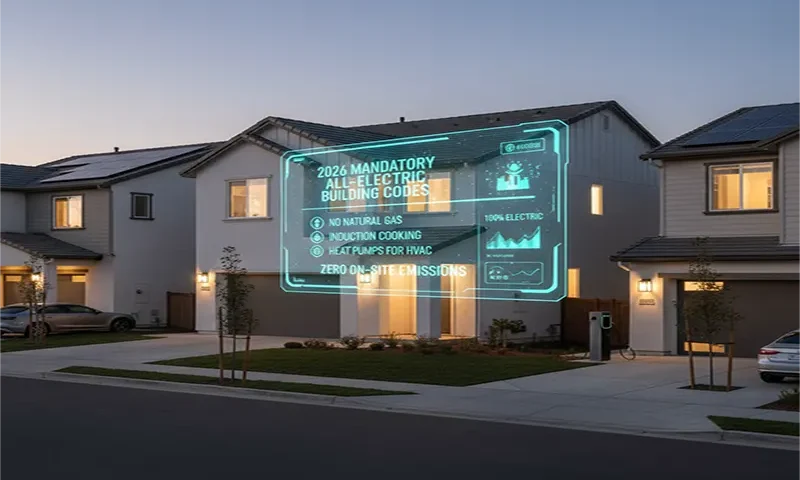
The year 2026 marks a definitive turning point in American residential architecture. What began as a series of local municipal “gas bans” has evolved into sweeping state mandates that have fundamentally altered the blueprint of the modern home. As of January 1, 2026, the transition to all-electric construction is no longer a voluntary pursuit for the “green” elite; in major markets like New York and California, it is now the law of the land.
For developers, architects, and municipal planners, this shift represents a move toward decarbonizing the building sector—which currently accounts for roughly $30\text{–}35\%$ of state-level greenhouse gas emissions.
1. Legal Framework: Understanding the 2026 Mandates
Two major regulatory engines are driving the 2026 electrification surge.
The New York Model: The All-Electric Buildings Act
New York has officially become the first state to prohibit fossil-fuel equipment in most new residential construction. Under the All-Electric Buildings Act, building permit applications filed after December 31, 2025, for buildings seven stories or fewer must be fully electric.
- The Prohibition: No natural gas, propane, or fuel oil equipment for space heating, domestic hot water, or cooking.
- The “Gas Hookup” Ban: New construction in 2026 is barred from installing gas piping infrastructure entirely.
The California Model: 2025 Title 24 Energy Code
California’s latest update to the Title 24 Building Standards took effect on January 1, 2026. Rather than a flat ban, California utilizes a “Performance Pathway” that sets energy budgets so stringent they effectively mandate electric heat pumps as the default.
- Electric-Ready Requirements: All new homes not utilizing all-electric systems must still be “electric-ready,” equipped with dedicated $240\text{V}$ circuits and panel space for future conversion.
2. Critical Infrastructure: The All-Electric Blueprint
Designing a home in 2026 requires a “load-first” mentality. The removal of the gas line necessitates a more robust electrical backbone.
The Heat Pump Core
The centerpiece of the 2026 home is the Cold-Climate Heat Pump (CCHP). Unlike older models, 2026 CCHPs utilize advanced variable-speed compressors that maintain high efficiency even at temperatures as low as $-25^{\circ}C$ ($-13^{\circ}F$).
Induction Cooking and Load Management
Induction has officially surpassed gas in the “chef-preferred” category due to its precision and safety. From a code perspective, this requires a $200\text{A}$ minimum service panel to accommodate the simultaneous loads of an induction range, heat pump water heater, and mandatory EV-ready charging circuits.
3. The Economics of Electrification: Cost vs. Benefit
While critics argue that electrification increases construction costs, the 2026 data tells a different story focused on Avoided Infrastructure.
Immediate Capital Savings
By eliminating gas, developers avoid the significant cost of digging gas trenches, installing meters, and plumbing interior gas lines.
- Estimated Savings: Developers report saving between $\$2,000$ and $\$5,000$ per lot in avoided fossil-fuel infrastructure.
Operational Efficiency ($COP$)
The primary economic driver for the homeowner is the Coefficient of Performance (COP). A standard gas furnace has a maximum theoretical efficiency of $98\%$, whereas a 2026 heat pump can deliver four units of heat for every one unit of electricity consumed.
$$COP = \frac{Q_{out}}{W_{in}}$$
In 2026, a $COP$ of $3.0$ to $4.0$ is the standard for new residential installs, drastically lowering monthly utility bills despite rising electricity rates.
4. Mandatory Electrification Timeline (2026–2030)
| Requirement | 2026 Standard (NY/CA) | 2029–2030 Global Goal |
| New Single-Family | Mandatory All-Electric | Standardized Nationwide |
| Multifamily (<7 stories) | Mandatory All-Electric | Net-Zero Energy Required |
| Commercial Kitchens | Electric-Ready (CA) | Mandatory Induction |
| HVAC | Cold-Climate Heat Pump | $COP \geq 4.0$ Standard |
| EV Infrastructure | Level 2 Ready | Bidirectional (V2H) Ready |
5. Challenges: Grid Reliability and Consumer Sentiment
The transition has not been without friction. The “Winter Peak” concern remains a primary focus for municipal planners. As thousands of homes switch to electric heating simultaneously, utilities are investing heavily in Demand Response programs and residential battery storage to buffer the grid during extreme cold snaps.
Culturally, the “all-electric” home has become a status symbol of health and resilience. The elimination of nitrogen dioxide ($NO_2$) from indoor air—a byproduct of gas cooking—has shifted consumer sentiment toward a “wellness-first” home.
6. Leveraging the ‘OBBB’ Act of 2025
The federal landscape changed with the passage of the “One Big Beautiful Bill” (OBBB) Act in July 2025. While it rolled back some direct consumer tax credits for solar, it preserved and clarified the Section 45L New Energy Efficient Home Credit for builders.
- The 2026 Opportunity: Builders of all-electric homes that meet DOE Zero Energy Ready Home (ZERH) standards can still capture up to $\$5,000$ per unit in federal credits if construction begins before July 4, 2026.
The New Normal
The 2026 building codes are not merely a regulatory hurdle; they are a response to a changing climate and a volatile energy market. By mandating all-electric construction, New York and California have set a precedent that the rest of the country is already beginning to follow. In 2026, a home with a gas hookup is increasingly viewed as a “stranded asset”—a relic of a fossil-fuel past in a world that has moved on to a cleaner, more efficient, and more resilient future.

