
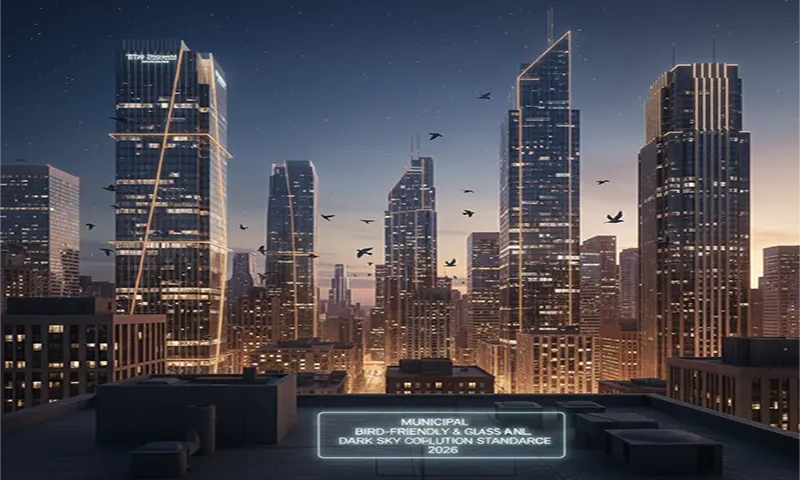
For decades, modern architecture has been defined by the pursuit of transparency—the glass-clad skyscraper standing as a symbol of openness and progress. However, as we inhabit 2026, the cost of this aesthetic has become impossible to ignore. Urban centers have increasingly become ecological “sinks,” with glass collisions claiming an estimated one billion birds annually in North America alone.
The response is a new era of “Perceptive Architecture.” Cities are no longer treating glass and light as neutral design elements but as active ecological hazards. From the federal level down to municipal zoning, new standards are transforming the “Invisible Infrastructure” of our cities into a bio-symmetric landscape that protects biodiversity while maintaining architectural excellence.
Bird-Friendly Glass: From 2×4 to the 2×2 Standard
The core of bird-friendly design is simple: birds do not perceive glass as a solid barrier. They see either a reflection of the sky and vegetation or a clear “fly-through” path to indoor plants. To break this illusion, glass must be treated with visual markers that signify a solid object.
The Evolution of Spacing Rules
In the early 2020s, the “2×4 Rule” (markers spaced 2 inches apart horizontally or 4 inches apart vertically) was the baseline. However, updated research on smaller migratory species has led to a stricter “2×2 Rule” in 2026. This tighter grid ensures that even the smallest songbirds, such as kinglets and wood-warblers, perceive the gap as too small to fly through.
Threat Factor (TF) Ratings
The architectural industry now uses the Threat Factor (TF) as the primary performance metric for glazing. Established by the American Bird Conservancy (ABC), the TF rating measures the percentage of bird collisions that occur compared to untreated glass.
- Target: Modern municipal codes (like NYC’s updated Local Law 15) now mandate materials with a TF of 25 or lower.
- Innovation: 2026 has seen a surge in UV-patterned glass, which features a coating that reflects ultraviolet light. Since many birds see into the UV spectrum, the patterns are highly visible to them but remain nearly invisible to the human eye, preserving the “clear glass” look desired by high-end developers.
Light Pollution: Restoring the Dark Sky
While glass is the daytime hazard, light is the nighttime trap. Artificial Light at Night (ALAN) disorients migratory birds, drawing them into urban cores where they become exhausted and collide with structures. In 2026, “Dark Sky Compliance” has moved from a voluntary certification to a core building code requirement.
The BUG Rating System
Lighting is now regulated through the BUG (Backlight, Uplight, and Glare) rating system, which provides a more precise measurement than the old “cutoff” terminology.
- Uplight (U): Must be zero ($U0$) for most residential and commercial zones to prevent “Sky Glow.”
- Backlight (B): Controlled to prevent “Light Trespass” into neighboring properties or wildlife habitats.
- Glare (G): Restricted to reduce visual discomfort for both humans and animals.
Color Temperature (CCT) and Adaptive Controls
2026 standards have largely banned high-intensity blue light (which scatters more easily in the atmosphere).
- CCT Limits: Municipalities now mandate a maximum Correlated Color Temperature (CCT) of 2700K to 3000K for all exterior luminaires.
- Dynamic Dimming: New codes require AI-driven adaptive controls that automatically dim exterior lighting by 50–80% after midnight or during peak migration windows (April–May and September–October).
Technical Comparison: Bird-Safe Treatments
Choosing a treatment involves balancing visibility, cost, and effectiveness.
| Treatment Type | Threat Factor (TF) | Human Visibility | Durability | Best Use Case |
| Ceramic Frit (Dots/Lines) | 15–25 | Moderate | High (Fired-on) | Commercial towers, high-impact zones. |
| Acid-Etched Patterns | 20–25 | Low to Moderate | Permanent | Luxury residential, high-end facades. |
| UV-Reflective Coating | 20–30 | Very Low | High (Internal) | Historic preservation, retail storefronts. |
| Surface Film (Retrofit) | 25 | Moderate | Medium (10-year) | Retrofitting existing “deadly” buildings. |
Legislation Spotlight: 2026 Regulatory Landscape
The Federal Bird Safe Buildings Act (2025/2026)
This landmark legislation now requires the General Services Administration (GSA) to incorporate bird-safe building materials and design features into all new federal buildings and major renovations (defined as altering >50% of the facade).
NYC Local Law 15 & Toronto Green Standard (v5)
- NYC: Requires bird-friendly materials on 90% of the first 75 feet of a building.
- Toronto: Now requires bird-friendly treatments for 85% of all exterior glazing within the first 16 meters of a building, coupled with strict “Lights Out” mandates for commercial properties.
The Convergence: The ‘Lights Out’ Synergy
The most effective strategy is a combined approach. When bird-friendly glass is paired with light reduction, the “Threat Factor” of a building drops exponentially. This synergy is now recognized by LEED v4.1, which offers pilot credits for “Bird Collision Deterrence.”
Developers are finding that these measures often have a “Green Co-benefit.” Bird-friendly frit patterns and external shading devices also reduce Solar Heat Gain Coefficient (SHGC), lowering the building’s cooling load and energy costs. At the Javits Center in NYC, the transition to bird-friendly fritted glass led to a 26% annual energy saving alongside a 90% reduction in bird fatalities.
The Bio-Symmetric City
In 2026, the definition of a “modern” building has shifted. We are moving away from the “arrogance of transparency” toward an architecture of empathy. Municipal bird-friendly and light pollution standards are no longer viewed as restrictive red tape; they are the baseline for a sustainable, luxury, and ethically constructed urban environment. By making our buildings “visible” to the species that share our skies, we are building a city that thrives both by day and by night.

