
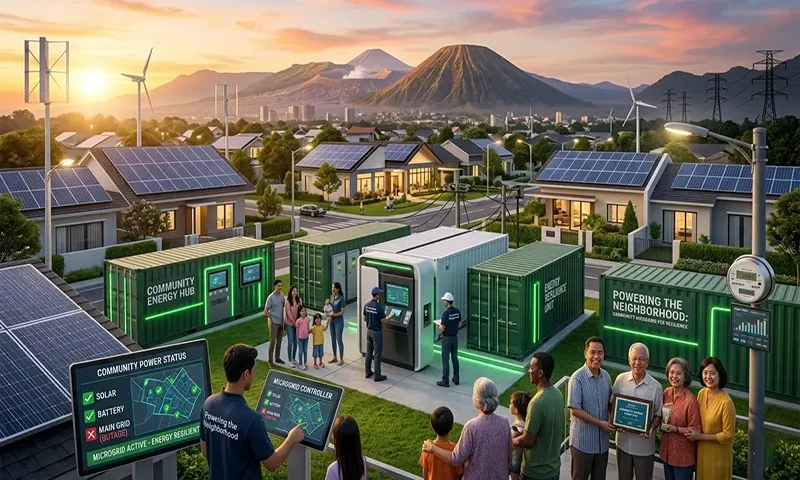
For over a century, our energy systems have relied on a top-down, centralized model. When a storm strikes or a transmission line fails, thousands of homes go dark simultaneously. However, as we move through 2026, a decentralization movement is taking hold. Neighborhoods are increasingly turning to community microgrids—localized energy networks that can “island” (disconnect) from the main grid during outages while remaining powered by their own renewable sources and battery storage.
A community microgrid is more than just a cluster of solar panels; it is the ultimate insurance policy against extreme weather and aging infrastructure, transforming a neighborhood from a passive consumer into an active energy participant.
The Three Pillars of a Microgrid
To function effectively, a microgrid requires three core technical components working in harmony:
- Generation: The source of power. This typically includes rooftop solar arrays on homes and community buildings, though wind turbines or small-scale combined heat and power (CHP) units can also be integrated to provide baseload reliability.
- Storage: The heartbeat of the system. Battery Energy Storage Systems (BESS) act as a buffer, capturing excess energy produced during the day to power the neighborhood through the night or during a grid failure.
- The Controller: The “brains” of the operation. This is sophisticated software that manages the flow of electricity, balances voltage, and triggers the “islanding” mechanism. When the main grid goes down, the controller seamlessly disconnects the neighborhood, allowing it to function as a self-sustaining cell until the external power is restored.
The Roadmap to Implementation
Launching a microgrid is a complex undertaking that requires both technical engineering and social consensus.
Phase 1: Feasibility and Stakeholders
Before touching hardware, you need a Community Energy Committee. This group—composed of tech-savvy residents, local business owners, and municipal representatives—must assess the neighborhood’s “load profile.” How much power do you actually use? Which buildings are “critical loads” (e.g., a community center with refrigeration or medical equipment)? Determining these priorities ensures that the system is sized correctly.
Phase 2: Regulatory Hurdles
This is often the most significant challenge. You must navigate your local utility’s interconnection process. In many jurisdictions, laws are still catching up to the technology of microgrids. You will likely need to engage with a legal partner who specializes in energy law to secure agreements that allow your microgrid to operate autonomously without violating utility monopolies or grid-safety protocols.
Phase 3: Financial Modeling
A community microgrid is a substantial capital project. Fortunately, the landscape for funding is robust in 2026. Beyond local tax incentives, federal grants for infrastructure resilience and “virtual power plant” (VPP) initiatives can cover a large portion of the initial costs. Many communities also utilize community-funded models, where residents invest in the system and receive dividends from the energy it produces.
Benefits Beyond Resilience: The Rise of VPPs
Perhaps the most exciting development in 2026 is the role of microgrids as Virtual Power Plants (VPPs). When your microgrid is connected to the main grid, it can act as a grid service provider. During peak demand, the utility may “rent” capacity from your neighborhood’s battery storage to prevent a city-wide blackout. This creates a revenue stream for the community, potentially offsetting the costs of installation and maintenance.
Readiness Checklist for Your Neighborhood
- [ ] Identify Critical Infrastructure: List buildings that must have power (community centers, grocery stores, shelters).
- [ ] Assess Solar Potential: Are the rooftops in your neighborhood suitable for solar installation?
- [ ] Community Buy-In: Do you have the support of at least 60–70% of the property owners in the proposed footprint?
- [ ] Engagement with Utility: Have you initiated a dialogue with your local distribution utility to understand their interconnection requirements?
- [ ] Professional Partners: Have you identified a solar developer and a microgrid controller engineer to perform a preliminary site study?
Addressing Challenges
Social friction is as significant as the technical challenge. Building consensus among neighbors regarding who pays, who benefits, and how the system is maintained requires transparency. Cybersecurity is another critical consideration; because the microgrid is a digital-physical hybrid, it must be protected against malicious actors looking to disrupt local power. Choosing high-quality, encrypted controllers is a non-negotiable expense.
From Dependency to Self-Reliance
Community microgrids represent a fundamental shift in how we think about energy. We are moving away from centralized dependency—where we are vulnerable to failures hundreds of miles away—toward collective self-reliance. While the path to setting one up is rigorous, the reward is a neighborhood that can stand resilient in the face of uncertainty. In an era where power security is increasingly synonymous with community security, a neighborhood that builds its own grid is a neighborhood prepared for the future.

