
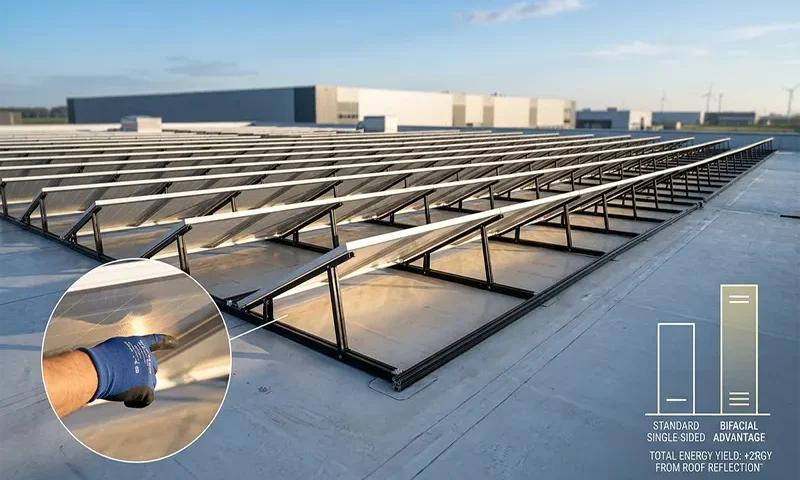
In the rapidly evolving landscape of commercial solar, the “flat roof” has long been viewed as a standard, utilitarian asset. However, as of 2026, a technological shift is transforming these vast, underutilized surfaces into high-performance power plants. The catalyst for this change is the adoption of bifacial solar modules, a technology that—when paired with the right surface strategy—is redefining the return on investment for commercial real estate.
The Science of Albedo: Power from the Bottom Up
Unlike traditional monofacial panels that feature an opaque backsheet, bifacial panels are engineered to capture sunlight from both sides. While the front side functions like a standard PV module, the rear side absorbs albedo—the light reflected off the surface beneath the array.
Albedo is a measure of a surface’s reflectivity, expressed on a scale of 0 to 1. A dark, black bitumen roof might have an albedo of just 0.05 (absorbing almost all light), while a high-quality white TPO (thermoplastic polyolefin) roof can reflect up to 80% of incoming sunlight. By pairing bifacial modules with high-reflectivity roofing, property owners can turn their entire roof surface into a secondary light source, effectively “bouncing” wasted light into the rear of the solar cells.
Key Advantages for Commercial Flat Roofs
1. Increased Energy Yield
In optimal conditions, bifacial panels can generate between 5% and 20% more energy than their monofacial counterparts on flat commercial roofs. By converting reflected light that would otherwise be absorbed as heat by the roof membrane, the system harvests “free” energy, significantly increasing the total kilowatt-hours (kWh) produced over the life of the asset.
2. Enhanced Durability (Glass-on-Glass)
Most bifacial modules in 2026 are constructed using dual-glass layering rather than a glass-and-plastic backsheet. This design is exceptionally resilient against moisture ingress, micro-cracking, and environmental degradation. For commercial owners, this equates to a longer performance warranty—often reaching 30 years—and greater peace of mind regarding the structural integrity of the solar array.
3. Optimized Levelized Cost of Energy (LCOE)
While bifacial modules carry a slight upfront cost premium, the “gain-to-cost” ratio frequently tilts in favor of bifacial technology. By extracting more energy from the same square footage, the system lowers the LCOE, shortening the payback period. In many 2026 commercial projects, the higher yield from bifacial arrays allows owners to reach their ROI goals in 6 to 9 years, even with the added cost of specialized racking.
The “Dual-Strategy” for Maximum Yield
To unlock the full potential of bifacial technology, property owners should adopt a dual-strategy approach:
- Rooftop Reflectivity: If the roof is due for a replacement or a coating, specifying a high-albedo (white) membrane is the single most effective way to boost bifacial gain. This creates a synergy where the roof cooling benefits and solar production benefits amplify one another.
- Engineered Mounting Systems: Standard flush-mount racks are insufficient for bifacial gain. Modern systems now utilize elevated mounting structures with optimized tilt angles (typically 10°–20°). These structures are engineered to be “light-transparent,” minimizing rear-side shading from support rails and allowing the maximum amount of light to reach the back of the modules.
Yield Comparison: Roof Surface Impact
| Surface Type | Typical Albedo | Estimated Bifacial Gain |
| Dark Bitumen / Rubber | 5% – 10% | 1% – 3% |
| Grey Polymer Membrane | 15% – 40% | 4% – 8% |
| White TPO / Cool Roof | 60% – 80% | 10% – 20% |
| Snow (Seasonal) | 80% – 90% | 20%+ |
Strategic Considerations and Challenges
Bifacial systems are not “set and forget.” Proper modeling using professional software (such as PVSyst or PVSol) is essential during the design phase to account for the “view factor”—how much light actually reaches the rear of the panel given the row spacing and mounting height. Furthermore, site maintenance is critical; on a high-albedo roof, keeping the surface clean is no longer just about the roof’s health, but about maintaining the light-reflectivity required to power the solar array’s rear side.
The New Standard
For the commercial property owner in 2026, the bifacial module is moving from a niche innovation to the primary choice for new installations. By viewing the rooftop as a dynamic, light-capturing asset rather than a passive surface, businesses can generate more power, improve their ESG credentials, and significantly bolster their bottom line. When combined with high-albedo roofing, bifacial technology represents the most sophisticated strategy currently available for maximizing energy density in an increasingly space-constrained world.

