
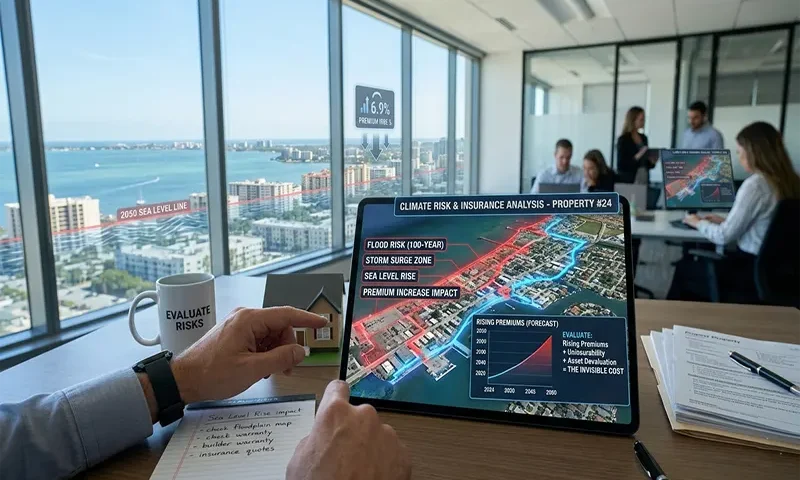
For decades, the standard checklist for a home purchase was straightforward: location, square footage, school district, and the home inspection report. However, as of 2026, a new, critical variable has moved to the top of the list: climate resilience.
In today’s market, a home can be in perfect physical condition and still represent a financial liability if it is located in a high-risk zone with soaring or unavailable insurance coverage. Evaluating climate risk and insurance affordability is no longer a “check-box” item; it is a fundamental pillar of modern financial planning.
Evaluating Climate Exposure
Before ever scheduling a showing, savvy buyers now perform their own “environmental audit.” The goal is to distinguish between a property’s present-day allure and its long-term viability in a changing climate.
- Public Data Tools: Use resources like the First Street Foundation’s Risk Factor or FEMA’s Flood Map Service Center to pull precise data on a property’s risk for wildfire, flood, wind, and heat. These tools don’t just look at past events; they project risk over the next 30 years—the typical lifespan of a mortgage.
- Future-Proofing: Look for markers of local resilience. Is the town investing in improved drainage, wildfire-break buffers, or updated sea walls? A home’s long-term value is tied not just to its own physical structure, but to the collective infrastructure of the surrounding community.
The Insurance Audit: Treat It Like a Mortgage Pre-Approval
Many buyers make the mistake of waiting until they are under contract to investigate insurance. By then, it may be too late to discover that the property is in a high-risk area where insurers are restricting new policies.
- The “Pre-Offer” Quote: Before you submit an offer, contact a licensed insurance broker and request a quote for the specific address. If an insurer refuses to write a policy—or if the premium is significantly higher than you anticipated—you need to know before you put your earnest money on the line.
- The CLUE Report: Always ask the seller for a Comprehensive Loss Underwriting Exchange (CLUE) report. This document details the insurance claims history for a property over the past five to seven years. If a house has had repeated flood or water-damage claims, it may be red-flagged by underwriters, making it impossible to insure at standard rates.
- The Coverage Gap: Remember that standard homeowner’s policies rarely cover the “big” climate risks. You must evaluate the cost of specialized riders for flood, wind/hail, and fire. In many cases, these separate policies can double your total annual insurance expense.
The Financial Ripple Effect
Insurance costs are a direct drag on your monthly housing budget. When underwriting a mortgage, lenders look at your Debt-to-Income (DTI) ratio. If your insurance premium spikes by several thousand dollars a year, that increase directly eats into your borrowing power.
Furthermore, consider the “exit strategy.” If you buy a home in a high-risk zone today, will a future buyer be able to get insurance on it in ten years? If climate risk makes a property uninsurable, its resale value can plummet, leaving you trapped in an asset that is difficult to sell or refinance.
Mitigation as a Strategy
You don’t have to walk away from every home with risk; instead, look for properties where you can implement mitigation strategies. Many insurers now offer “mitigation discounts” if you can prove you have hardened the home against local perils.
- Wildfire: Install non-combustible roofing, clear vegetation within the “defensible space,” and install ember-resistant vents.
- Flood: In flood-prone areas, consider installing flood vents or elevating electrical systems.
- Wind: Replace older roofing with impact-resistant shingles and upgrade garage doors and windows to meet modern wind-resistance codes.
Risk Evaluation Checklist for Property Tours
Keep this checklist handy when you visit properties:
- [ ] Check the Topography: Is the home at the bottom of a slope (flood risk) or at the top of a canyon (wildfire risk)?
- [ ] Roof Condition: Is the roof made of fire-resistant materials, or is it older wood/asphalt?
- [ ] External Features: Look for overhanging tree limbs, combustible fencing attached to the house, or lack of proper drainage around the foundation.
- [ ] Ask the Neighbors: Neighbors are often the most honest source of information regarding past flooding, wind damage, or how the property handles extreme weather.
Due Diligence 2.0
In 2026, the definition of a “good investment” has expanded. It is no longer just about the interior aesthetics or the neighborhood prestige; it is about the long-term environmental and financial health of the property. By treating insurance and climate risk as a priority equal to the home inspection, you protect yourself from the “invisible costs” of ownership. Taking the time to evaluate these risks today is the most effective way to ensure that your home remains a source of security and stability for years to come.

