
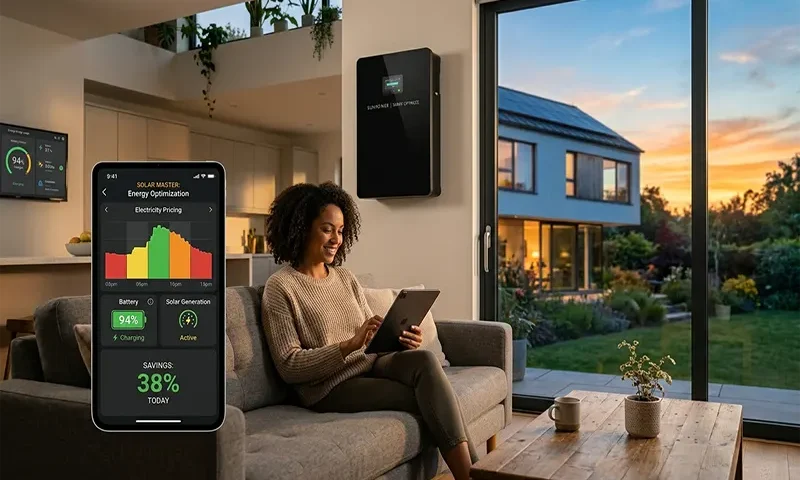
In the early days of residential solar, success was measured simply: how much energy did your panels generate, and how much could you offset on your monthly bill? That “set it and forget it” era has come to an end. In 2026, the modern home has evolved into an active participant in the energy market. By combining a home solar battery with smart tariff automation, you are no longer just a consumer; you are a “prosumer”—a home energy asset manager capable of playing the market to your financial advantage.
The Paradigm Shift: From Passive Storage to Energy Arbitrage
Traditionally, homeowners used batteries for self-consumption: storing midday solar to use during the evening. While effective, this ignores the volatility of modern wholesale electricity markets.
Today, dynamic or “Time-of-Use” (ToU) tariffs link your electricity rates to real-time grid demand and renewable supply. Prices fluctuate hourly—or even every 15 minutes. During periods of high renewable generation (like a windy or sunny afternoon), prices can drop to near zero or even turn negative. Conversely, during evening peak demand, prices can spike significantly.
Energy Arbitrage is the practice of automating your battery to “buy low” (charging from the grid when rates are pennies) and “sell or use high” (discharging your battery when grid prices are at their most expensive).
The “Why” of Automation
Manually tracking market prices and adjusting your battery settings is impossible. The true power lies in AI-driven Energy Management Systems (EMS). These systems function as the “brain” of your home, pulling live grid data, weather forecasts, and historical consumption patterns to make thousands of split-second decisions daily.
An intelligent EMS doesn’t just store solar; it performs predictive modeling. If the forecast predicts a cloudy tomorrow, your system will proactively “top up” your battery from the grid during the cheapest overnight hours, ensuring you avoid tomorrow’s expensive peak prices even without solar generation.
How to Maximize Your ROI
To transform your battery into a financial engine, focus on these three core strategies:
- Price Arbitrage (Grid-to-Battery): Use your EMS to charge your battery from the grid during the cheapest off-peak windows—usually between 1:00 AM and 5:00 AM. This fills your storage with low-cost energy, effectively “locking in” a low rate for your morning and evening usage.
- Peak-Shifting: Program your system to prioritize discharging your stored energy during your utility’s most expensive peak hours. By running your home on stored energy during these windows, you bypass the highest retail costs entirely.
- Export Optimization: If your tariff pays well for exports, smart automation can identify “premium” windows. It will hold onto your battery capacity throughout the day, releasing it back to the grid only when market prices hit maximum peaks, effectively turning your battery into a mini power plant.
Getting Started: Your Implementation Roadmap
- Check Your Compatibility: Ensure your solar inverter and battery system support API integration. Modern systems (like those from Deye, Victron, or GoodWe) often use standard communication protocols like CAN or Modbus, which are essential for third-party EMS software.
- Select a Dynamic Energy Partner: Move away from fixed-rate contracts. Look for energy providers offering dynamic or wholesale-indexed tariffs (e.g., those similar to Octopus Agile or Amber Electric) that provide the granular data necessary for automation.
- Install a Smart Monitor: A high-resolution energy monitor (such as those providing 1Hz or millisecond-level sampling) acts as the “eyes” of your system, providing the data granularity needed for accurate decision-making.
- Define Your “Buffer”: Always set a “critical backup” limit in your software. This ensures that while you are playing the market, you always retain a reserve of energy in case of a grid outage.
The Future: Virtual Power Plants (VPPs)
By automating your battery today, you are preparing your home for the next evolution: Virtual Power Plants. In the near future, you will be able to bundle your battery capacity with thousands of other homes to provide grid stability services. Grid operators will pay households to automatically dispatch power during emergencies, providing a brand-new revenue stream for your hardware investment.
Solar is no longer just a hobby; it is a professionalized service that manages itself. By embracing smart tariff automation, you decouple your home from the volatility of retail electricity prices. You aren’t just saving on your monthly bill—you are building an autonomous, high-efficiency energy system that maximizes the lifetime value of your solar investment.

