
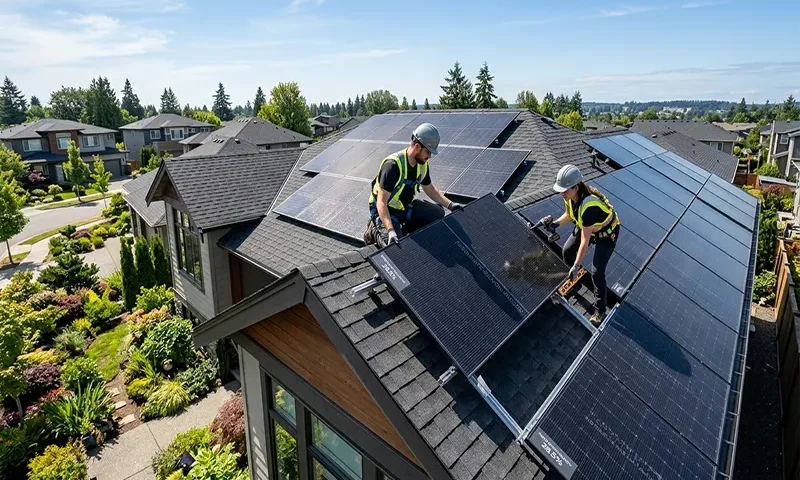
In the fast-moving world of renewable energy, few technologies have generated as much “hype versus reality” discussion as perovskite-silicon tandem solar cells. If you have been following the news, you have likely seen headlines about laboratory efficiency records shattering the 34% barrier. But if you call your local solar installer today, you won’t find these panels on their shelf.
As of mid-2026, the short answer is: No, they are not yet available for mainstream residential installation. While the technology has moved from the laboratory to early-stage commercial pilot programs, it has not yet reached the scale, reliability, or warranty maturity required for your average rooftop.
Understanding the Tandem Breakthrough
To understand why this technology is so exciting—and why it’s not yet in your garage—we have to look at the physics. Traditional solar panels use a single layer of crystalline silicon. While silicon is reliable and cheap, it has a “speed limit” (the Shockley-Queisser limit) on how much of the solar spectrum it can convert into electricity.
A tandem cell breaks this limit by layering a perovskite material on top of the silicon.
- The Top Layer (Perovskite): Captures high-energy light (blue and green wavelengths) that silicon often misses.
- The Bottom Layer (Silicon): Continues to capture lower-energy (red and infrared) light.
By working together, these two layers can theoretically push efficiencies toward 40% and beyond. In 2026, we are seeing the first commercial modules from companies like Oxford PV hitting 24–27% efficiency, a meaningful jump over the 20–23% typical of standard monocrystalline panels.
The 2026 State of Play: Pilot vs. Production
While the headlines are impressive, the transition to residential rooftops is a multi-year process:
- Utility-Scale First: The first commercial tandem modules were shipped for large-scale utility projects in late 2024. These environments are controlled, easier to maintain, and provide the “real-world” testing data needed for the manufacturers to refine their product.
- The “Hostile” Residential Roof: A residential roof is a harsh environment. Panels must endure 25 years of extreme heat, freezing temperatures, high humidity, and physical stress (like hail or wind) without degrading. Silicon has a proven track record here; perovskite, while promising, is still working to match that decades-long stability in the field.
- Manufacturing Scale: We are currently in the “pilot” phase. Global production capacity is still a tiny fraction of the market. Manufacturers like Hanwha Qcells and GCL are building out production lines, but mass-market availability is broadly expected to ramp up between 2027 and 2030.
Should You Hit the Pause Button?
If you are planning a solar installation for your home, the industry consensus is clear: Do not wait for tandem technology.
If you delay your project today, you are essentially betting that the efficiency gains of future tandem panels will outweigh the financial and environmental benefits of generating your own power right now. In the meantime:
- Current Silicon is Exceptional: Modern “workhorse” technologies like TOPCon (Tunnel Oxide Passivated Contact) and HJT (Heterojunction) are providing industry-leading efficiency, 25-to-30-year warranties, and are competitively priced. They are “bankable,” meaning insurers and lenders fully trust their performance.
- The “Efficiency Gap” is Small: While tandem cells may eventually offer 15–25% more output for the same area, a high-quality, high-efficiency silicon system installed today will serve you perfectly well for the next three decades.
- The Cost of Waiting: By installing now, you start saving on your utility bills immediately. The ROI on today’s high-performance silicon panels is proven and reliable.
The Bottom Line
Perovskite-silicon tandem cells represent the next frontier of solar power. They will eventually play a critical role, especially for homeowners with limited roof space who need every available watt of output. However, in 2026, they remain a “future” technology.
For now, the best strategy is to embrace the highly efficient, mature silicon technology available today. Your roof is an asset that performs best when it is generating power, not when it is waiting for a technological breakthrough.

