
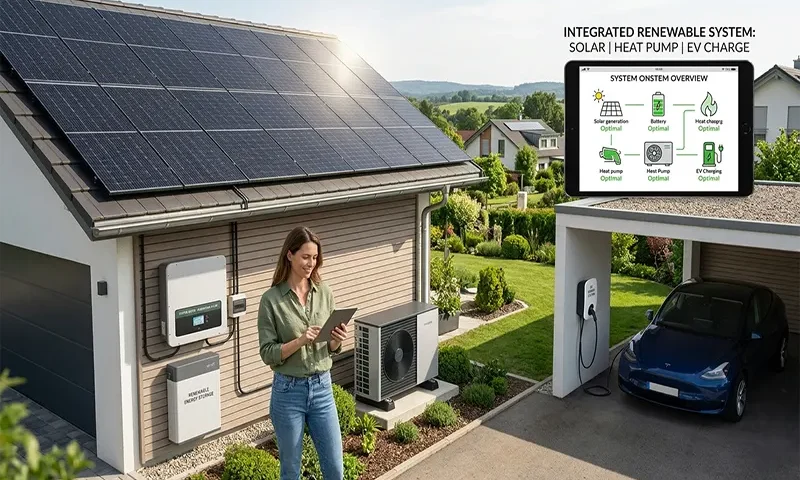
In the past, upgrading your home’s energy infrastructure meant installing “silos”—a solar array here, a heat pump there, and an EV charger in the garage, all operating independently. In 2026, the paradigm has shifted. The modern home is no longer just a place of consumption; it is an active, intelligent power plant. By integrating solar PV, battery storage, heat pumps, and electric vehicle (EV) charging into a unified ecosystem, you can transition from a passive utility customer to a proactive energy asset manager.
The Architecture of an Integrated Home
Building an integrated system is about creating a “connected network” where every component talks to the others. In this setup, your home’s energy flow is governed by a central intelligence that treats electricity as a flexible, dynamic resource.
- The Solar PV Array: Your primary generator. In an integrated system, the panels don’t just “send power to the house”; they provide the foundational energy layer for your heating, mobility, and storage.
- The Battery Storage System: Your temporal bridge. It decouples generation from consumption, allowing you to capture midday solar abundance and shift it to the evening peak.
- The Heat Pump: Your thermal battery. Because heat pumps are highly efficient, they can be “over-fired” during solar peaks to pre-heat your home or domestic hot water tank, turning your living space into a thermal store.
- The Smart EV Charger: Your mobile battery. With modern bidirectional-capable hardware, your car becomes a massive storage asset, capable of soaking up excess solar or providing backup power to the home.
The Brain: The Home Energy Management System (HEMS)
The most critical component is the Home Energy Management System (HEMS). Without it, your devices compete for power; with it, they collaborate. The HEMS acts as the “orchestrator,” pulling in real-time data from smart meters, local weather forecasts, and dynamic electricity tariffs to make thousands of micro-decisions daily.
It follows a sophisticated priority logic:
- Direct Self-Consumption: All critical household loads are powered first by real-time solar.
- Thermal & Storage Buffering: If surplus solar remains, the HEMS directs power to the heat pump (to increase the set-point temperature of your water/home) or the battery.
- EV Charging: Once the house and battery are “full,” the EV charger engages. If solar production dips, the HEMS modulates the charging speed, ensuring you stay within your home’s total electrical capacity without tripping a breaker.
- Grid Arbitrage: During peak-price hours, the HEMS pauses grid imports, drawing instead from the battery to power your evening activities and your heat pump’s cycle.
Designing for Maximum Efficiency
To ensure these components communicate seamlessly, you must prioritize interoperability during the design phase:
- Communication Protocols: When selecting hardware, look for “SG Ready” (Smart Grid Ready) labels for heat pumps and open API support for inverters and chargers. Ideally, aim for a “single-ecosystem” approach—using a single brand or a fully compatible set of partners (e.g., inverters and batteries from the same manufacturer) to avoid the “translation errors” that occur between disparate cloud platforms.
- Load Balancing: Ensure your EV charger supports “dynamic load balancing.” This hardware monitors your total home consumption in real-time and throttles your car’s charging speed so that you never exceed your main fuse rating, even when your heat pump and oven are running simultaneously.
- Future-Proofing: If you aren’t ready to buy a bidirectional EV yet, at least install a charger and inverter that are “V2H/V2G (Vehicle-to-Home/Grid) ready.” This allows you to simply swap your car or update firmware later to unlock full grid-support capabilities.
The Financial Case for Integration
The financial reality of 2026 is that “exporting” your solar energy to the grid for a low feed-in tariff is the least efficient way to use it. The true ROI of an integrated system comes from avoided costs. By using your own power to heat your home and fuel your commute, you bypass the “retail markup” of grid electricity, which is increasingly volatile.
Integration is the only way to minimize waste. A standalone solar system might export 50% of its energy; an integrated HEMS-managed system can push that self-consumption rate toward 80–90%, shortening your payback period significantly while insulating your household against energy price spikes.
The Active Home
Building an integrated energy system is the foundation of the future-ready home. It is an investment in both financial resilience and environmental stewardship. By moving beyond individual gadgets and embracing a unified, intelligent energy architecture, you are not just reducing your carbon footprint—you are securing your household’s independence in the new, decentralized energy economy.

