
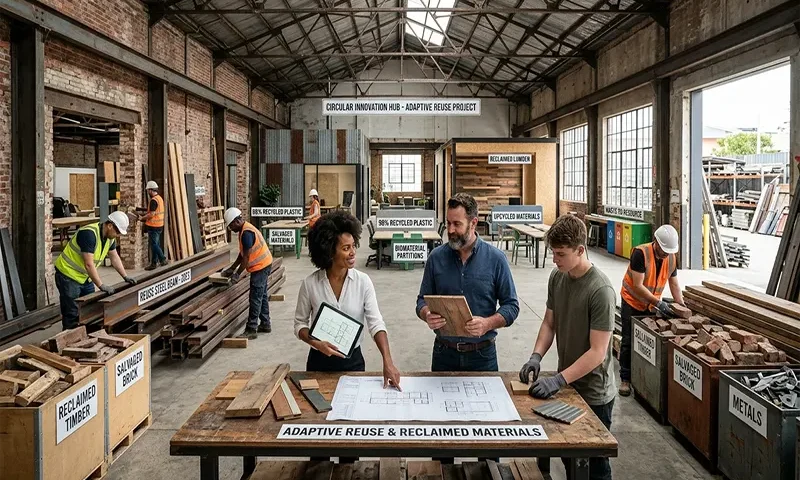
In 2026, the commercial real estate sector faces a dual challenge: stringent ESG reporting requirements and the volatility of global material supply chains. As regulatory frameworks like the EU Taxonomy and various “Retrofit First” municipal policies shift from guidance to enforcement, the industry is undergoing a fundamental transformation.
We are moving away from the traditional “take-make-dispose” model of construction. Today, the most forward-thinking developers view adaptive reuse not merely as a renovation project, but as a strategic circular transformation. By maintaining the embodied carbon of existing structures and treating buildings as material banks, developers can unlock long-term asset value while future-proofing their portfolios against carbon taxation and resource scarcity.
The Foundation: The Building as a Material Bank
A circular approach treats every existing commercial structure as a repository of valuable resources—steel, concrete, timber, and glass—that have already incurred their “carbon debt.” Adaptive reuse is the ultimate expression of circularity; it preserves this embodied carbon while preventing the massive waste associated with demolition.
To move from theory to practice, implementation must follow a rigorous, data-driven methodology:
1. Resource Auditing and Material Passports
Before a single design choice is made, you must understand your asset’s inventory.
- Material Pathway Audits (MPAs): Instead of standard waste management plans, conduct audits that catalog existing components, assess their structural integrity, and determine the “highest-value pathway” for each element—whether that is in situ retention, refurbishment, or selective harvesting for reuse elsewhere.
- Digital Material Passports: Utilize BIM (Building Information Modeling) to create “passports” for every major component. These digital records track the chemical composition, origin, and reusability of materials, ensuring transparency for future renovations and enabling easy compliance with ESG audit requirements.
2. Design for Disassembly (DfD)
Adaptive reuse often involves adding new interior systems. The circular mandate here is to ensure these new additions don’t become tomorrow’s demolition waste.
- Mechanical Fasteners: Replace adhesives, mortars, and chemical bonds with mechanical fasteners (bolts, screws, and clips) wherever possible. This allows interior partitions, raised floors, and facade systems to be disassembled at the end of their service life without damaging the base structure.
- Modular Infill: Adopt “kit-of-parts” strategies where interior office layouts are comprised of reconfigurable, modular components. This increases flexibility for future tenants, allowing the space to pivot between uses (e.g., from corporate office to co-working or residential) without major gut renovations.
3. Material Circularity and Secondary Sourcing
The “circular” label is earned by reducing reliance on virgin materials.
- Secondary Procurement: Prioritize reclaimed structural steel, salvaged timber, and low-carbon recycled concrete for structural reinforcements.
- Product-as-a-Service (PaaS): Shift procurement models for lighting, HVAC, and flooring. By leasing these systems from manufacturers who retain ownership, you guarantee their eventual return to the producer for remanufacturing, effectively offloading the burden of “end-of-life” management to the experts.
4. Adaptability as an Asset Class
Circular architecture is inherently flexible. Designing for “circular uses”—such as intensified or multiple uses—ensures that an asset can remain relevant for decades. This adaptability is a potent risk-mitigation strategy; an asset that can be easily repurposed is far less likely to become a “stranded asset” due to changing market demands or tightening energy performance standards.
Overcoming the 2026 Implementation Barriers
Implementing circularity is not without challenges. Building codes are often optimized for virgin materials, and the logistics of reverse supply chains are still emerging. To navigate this:
- Early Engagement: Involve engineers and local authorities early in the design process to certify the safety and performance of reclaimed elements.
- Data Integration: Use integrated cloud-based BIM systems to share real-time data across the entire supply chain, from the demolition contractor to the final occupant.
The Financial Case for Circularity
For the commercial developer, circularity is no longer an “extra.” It is a core financial strategy.
- Risk Mitigation: It provides a hedge against volatile raw material prices.
- Regulatory Compliance: It streamlines the process of meeting mandatory whole-life carbon assessments and energy performance certifications (e.g., Class E/D requirements).
- Asset Value: Buildings designed with circular principles command higher premiums from tenants who are themselves under pressure to meet Scope 3 emissions reporting.
From Disposable to Regenerative
The transition from “disposable architecture” to “regenerative urban assets” is the defining challenge of our time. By implementing circular principles in adaptive reuse, developers can turn yesterday’s obsolete office buildings into tomorrow’s high-performance assets. In a world of finite resources, the most sustainable building is not just the one that is built—it is the one that is designed, from its very foundations, to last, adapt, and evolve.

