
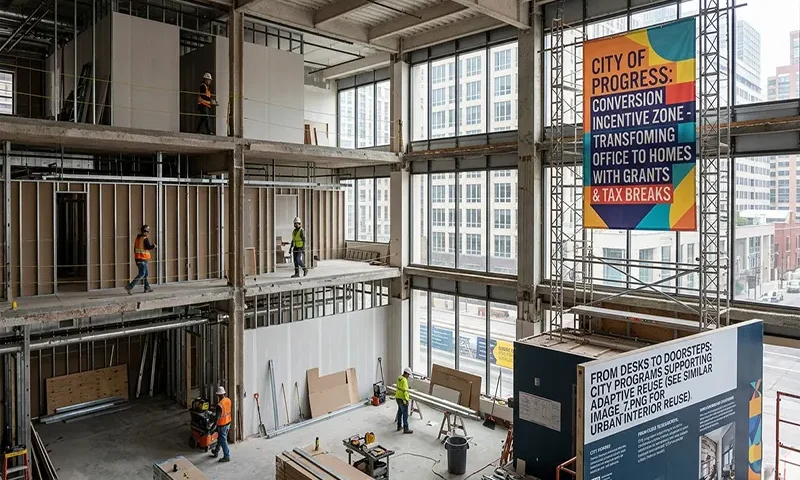
The urban landscape is currently defined by a “double crisis.” Across North America and Europe, central business districts are grappling with record-high commercial office vacancies—a structural shift accelerated by the permanent adoption of hybrid and remote work. Simultaneously, these same cities are facing a crippling housing shortage. Adaptive reuse, the process of converting obsolete office buildings into residential apartments, has emerged as the most viable strategy to bridge this gap, yet it is fraught with technical and financial complexity.
To turn ghost offices into vibrant living spaces, cities are moving beyond mere encouragement; they are creating sophisticated, multi-layered incentive toolboxes to de-risk these projects and stimulate private investment.
The Technical and Financial Hurdles
Adaptive reuse is rarely a simple “plug and play” scenario. Office buildings were designed for high-density, daytime-only occupancy, whereas residential buildings require 24/7 infrastructure. Key hurdles include:
- Floor Plate Depth: Large office floor plates often result in interior spaces without natural light or ventilation.
- Plumbing & HVAC: Residential units require a significantly higher ratio of bathrooms and kitchens, necessitating a complete overhaul of vertical plumbing stacks.
- Safety Codes: Upgrading older structures to meet modern fire, seismic, and accessibility codes often costs nearly as much as new construction.
These challenges create a “viability gap” where the cost of conversion exceeds the expected market value of the finished apartments. Cities are now intervening to bridge this gap.
The Incentive Toolbox
To attract developers, cities are utilizing three primary levers: financial subsidies, regulatory relief, and code modernization.
Financial Incentives: Comparative Analysis
| Incentive Type | Effectiveness | Implementation Speed | Best For |
| Direct Capital Grants | High | Fast | Offsetting immediate “hard costs” of structural/plumbing retrofits. |
| Tax Abatements | Moderate | Slow | Long-term operational viability and incentivizing affordability. |
| TIF (Tax Increment Financing) | High | Moderate | Revitalizing entire districts via infrastructure upgrades. |
Direct Capital Grants (like those pioneered in Calgary) are currently seen as the “gold standard” for effectiveness. Because the upfront costs of conversion are so high, a grant that covers a percentage of construction helps projects pencil out immediately, preventing the “wait-and-see” approach that often stalls development.
Regulatory Relief and Zoning Reforms
Cities like Los Angeles have demonstrated that money isn’t the only solution—time is, too. Adaptive reuse ordinances are being used to “upzone” office districts, allowing residential use by-right. By streamlining the permitting process and eliminating requirements for excessive parking—which is often impossible to fit into retrofitted basements—cities are removing the bureaucratic bottlenecks that traditionally killed these projects.
Code Modernization
Rigid building codes are the enemy of adaptive reuse. Forward-thinking municipalities are adopting “performance-based” codes. Instead of mandating specific, standardized requirements that may not fit a historic or oddly shaped office building, these codes allow architects to prove that a building meets modern safety standards through alternative designs or materials.
Success Blueprints: Lessons from the Field
- Calgary, Canada: Often cited as the global leader, Calgary implemented a $100M+ grant program specifically targeted at converting office towers. By providing a fixed-dollar-per-square-foot subsidy, they have successfully brought thousands of residential units into their downtown core.
- Chicago, USA: Chicago has leaned heavily on Tax Increment Financing (TIF) and historic tax credits to incentivize the transformation of iconic but vacant office buildings along its LaSalle Street corridor into mixed-income residential housing.
- New York, USA: NYC is currently testing aggressive zoning modifications that allow for the conversion of office buildings constructed as late as the 1990s, expanding the pool of eligible stock significantly beyond the traditional “historic” buildings.
The Future of Adaptive Reuse: Digital Intelligence
As of 2026, the industry is increasingly using Generative AI to conduct “feasibility scans.” Instead of manually reviewing floor plans for hundreds of buildings, developers can now use AI to analyze thousands of building footprints simultaneously, identifying those with the ideal floor-plate depth and window-to-core ratio for residential conversion. Furthermore, the push for Digital Product Passports in building materials ensures that developers understand the exact carbon profile and potential for material reuse within the existing structure, further lowering the total cost of ownership.
Building the 24/7 City
The office-to-residential conversion movement is more than a temporary fix for empty real estate; it is a fundamental shift toward the “24/7 city.” By transforming monolithic office districts into mixed-use neighborhoods, cities are creating environments that are more resilient to economic shocks and more responsive to human needs. Through the strategic use of capital grants, regulatory flexibility, and data-driven planning, cities are proving that the most sustainable way to build the future is to intelligently repurpose the past.

