
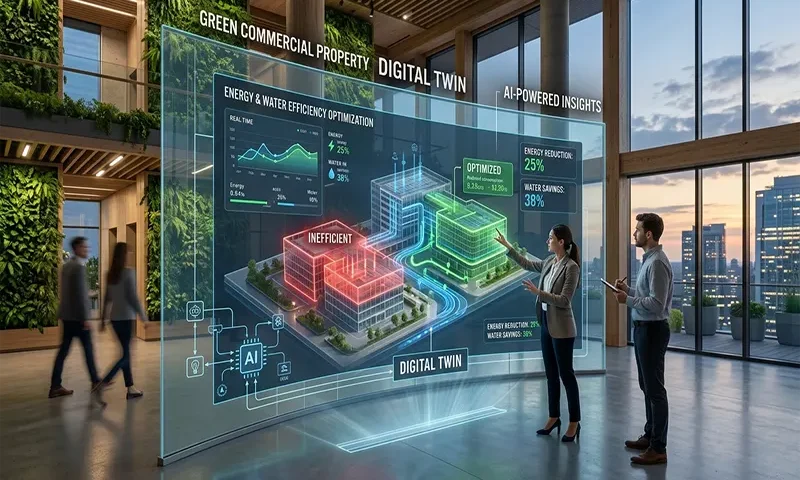
In the professional landscape of 2026, the term “Digital Twin” has evolved from a futuristic visualization concept into the essential “brain” of high-performance commercial buildings. It is no longer just a static 3D model; it is a dynamic, living replica that bridges the physical structure with real-time data to drive the path toward Net Zero.
The Mechanics of Optimization
The power of an AI-powered digital twin lies in its Perception-Cognition-Decision loop, which functions as a continuous feedback system for facility operations:
- Perception: A dense network of IoT sensors—monitoring everything from HVAC thermal zones and lighting occupancy to acoustic leak detection in plumbing—feeds raw data into the twin in real-time.
- Cognition: Advanced AI algorithms, often utilizing deep reinforcement learning, ingest this data. Unlike traditional static programs, these AI models identify complex patterns and inefficiencies that are invisible to human operators.
- Decision: The twin performs “what-if” simulations. Before a mechanical change is made, the twin tests the outcome virtually. It then automatically adjusts setpoints for HVAC, lighting, or irrigation to maximize efficiency without sacrificing occupant comfort.
Key Areas of Impact
AI-powered twins are fundamentally changing how we manage a building’s most precious resources:
- Energy: Digital twins enable dynamic load-shifting, where the building automatically throttles energy consumption based on grid pricing or solar availability. Predictive maintenance is perhaps the most significant benefit; by detecting abnormal vibration or thermal signatures in a chiller or boiler, the twin alerts teams to fix the issue before the hardware fails, preventing massive energy spikes and costly downtime.
- Water: Modern twins go beyond mere monitoring. Using high-frequency acoustic sensors, they can pinpoint microscopic leaks in plumbing walls that would otherwise remain hidden for months. Furthermore, they optimize irrigation systems by integrating hyper-local weather forecasting, ensuring that grounds are watered only when absolutely necessary and utilizing graywater recycling systems at peak efficiency.
Strategic Comparison: Traditional vs. AI-Twin Management
| Metric | Traditional Building Management | AI-Twin Powered Management |
| Maintenance | Reactive (Fix-when-broken) | Predictive (Fix-before-failure) |
| Energy Waste | High (Static, pre-set schedules) | Minimal (Dynamic, adaptive load-shifting) |
| Operational Costs | Variable/Unpredictable | Optimized/Data-driven |
| Tenant Experience | Manual adjustment based on complaints | Proactive comfort based on real-time needs |
Addressing the Challenges of 2026
While the vision is compelling, the “data island” problem remains the primary hurdle. Commercial buildings often have data siloed in disparate systems—BMS, CAFM, and energy portals—that do not communicate. For 2026, the industry is shifting toward standardized data protocols and “AI-ready” foundations. Leaders are realizing that AI outputs are only as good as the underlying data structure; cleaning asset registers and normalizing naming hierarchies is now recognized as a prerequisite for any successful twin project.
Future Outlook: Toward Autonomy
The trajectory for the next few years is clearly toward autonomous building management. We are moving toward a state where the AI-twin manages routine property operations with minimal human intervention, escalating only high-level anomalies to facility managers. By transforming buildings from passive assets into active, self-optimizing participants in the circular economy, digital twins are becoming the cornerstone of asset valuation and the primary tool for meeting increasingly stringent decarbonization compliance standards like LEED v5.

