
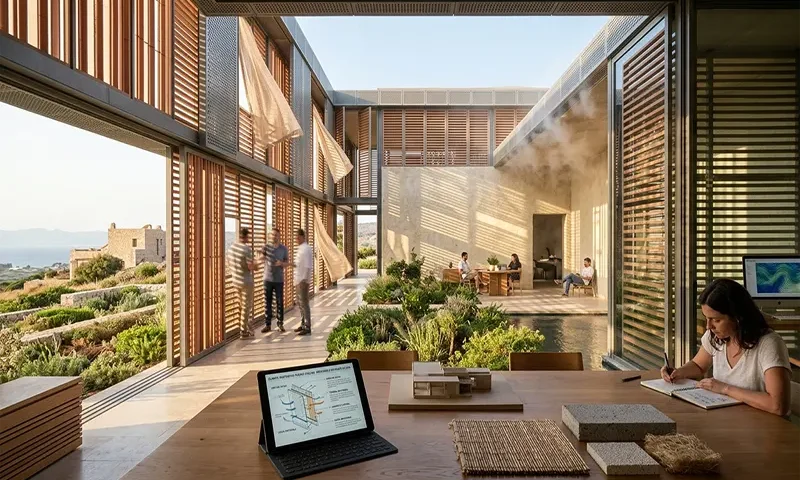
How to Design Breathable Building Envelopes for Climate-Responsive Passive Cooling
In the quest for net-zero construction, the industry has long obsessed over the “sealed thermos” approach—creating hyper-insulated, airtight envelopes. While effective for heating-dominated climates, this strategy often leads to overheating and poor indoor air quality in warmer, humid, or cooling-dominated regions.
The modern solution lies in the breathable building envelope: a design philosophy that treats the building skin not as a static barrier, but as a dynamic, climate-responsive filter. By mastering the interplay of vapor permeability, thermal mass, and natural convection, architects can achieve significant passive cooling and long-term structural durability.
The Physics of Breathability: Beyond the “Leaky” Envelope
There is a fundamental technical distinction between a “leaky” building—which suffers from uncontrolled infiltration and energy loss—and a “breathable” building.
A breathable envelope is airtight but vapor-permeable. It prevents unwanted drafts and air leakage while allowing moisture vapor to migrate through the assembly. This “hygrothermal” performance is essential; it … READ MORE ...
