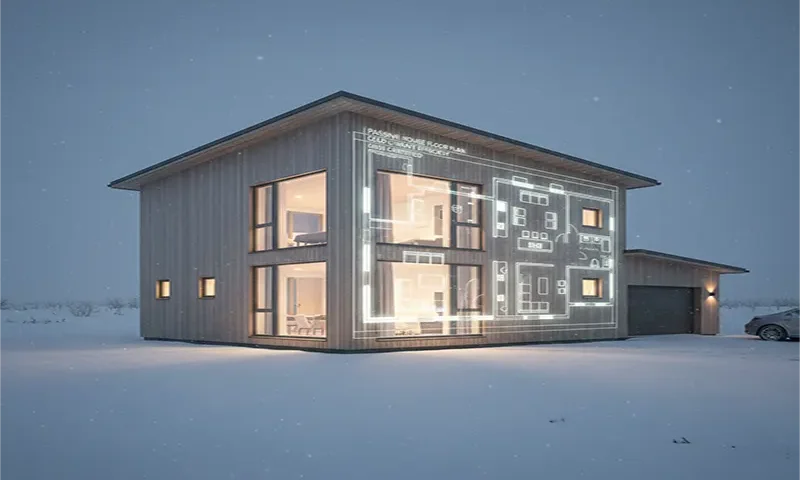
Contemporary Passive House Floor Plans for Cold Climate Efficiency
In the architectural landscape of 2026, the definition of a “home” has shifted. As climate volatility introduces more frequent and severe polar vortices, the Passive House standard has graduated from a niche environmental goal to a critical blueprint for absolute resilience. In cold climates, a modern floor plan is no longer just about aesthetics; it is a thermal strategy—a “Fortress of Warmth” designed to maintain habitable temperatures for weeks, even during total grid failure.
The 2026 Passive House—certified by the Passive House Institute (PHI) or Phius—utilizes the latest in vacuum insulation, bio-based structural cores, and AI-driven thermal orchestration to achieve a 90% reduction in heating energy compared to legacy building stock.
1. The Anatomy of a Cold-Climate Envelope
To survive sub-zero winters, the building envelope must transition from a “skin” to a high-performance “shield.”
Super-Insulation & The CLT Revolution
Traditional stick-framing is being replaced by Cross-Laminated Timber (CLT)… READ MORE ...