
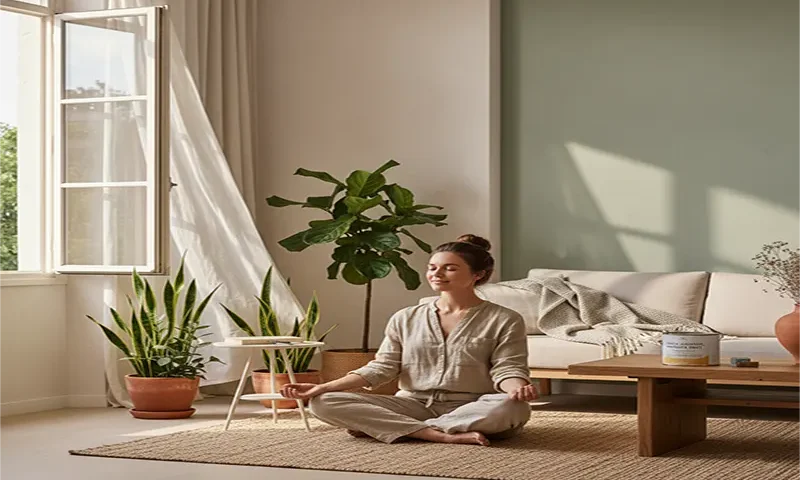
We spend approximately 90% of our lives indoors, yet the air we breathe inside our homes is often two to five times more polluted than outdoor air. While we frequently blame external smog or industrial emissions, one of the most persistent contributors to poor Indoor Air Quality (IAQ) is right before our eyes: the paint on our walls.
For decades, the gold standard for “healthy” paint was “Low-VOC.” However, as we move into 2026, the architectural community is looking beyond simple VOC (Volatile Organic Compound) counts toward a more ancient, chemically superior solution: Mineral-Based Paints. Unlike modern synthetic paints that coat walls in a plastic film, mineral paints are inorganic, breathable, and chemically reactive, offering a radical improvement in domestic wellness.
The Invisible Burden of Standard Paint
Traditional “Latex” or “Acrylic” paints are essentially liquid plastics. They rely on petroleum-derived binders to create a film that sits on top of a surface. Even those labeled “Zero-VOC” can be misleading. While they may not contain regulated solvents, they often utilize SVOCs (Semi-Volatile Organic Compounds) and toxic biocides to prevent mold growth inside the can.
These chemicals undergo “off-gassing,” a process where they are slowly released into the home for years after the paint has dried. This phenomenon is a primary driver of Sick Building Syndrome (SBS), manifesting as headaches, respiratory irritation, and long-term endocrine disruption. Mineral paints eliminate this burden by replacing carbon-based chemistry with earth-based geology.
What is Mineral Paint? The Chemistry of Inorganic Coatings
Mineral paints do not “dry” in the traditional sense; they cure through chemical reactions. The three primary pillars of this category include:
1. Silicate Paint (Liquid Glass)
Invented in the 19th century by A.W. Keim, silicate paint uses potassium silicate as a binder. When applied to a mineral substrate (like plaster, stone, or brick), it undergoes petrification (silicification). The paint chemically bonds to the wall, becoming an integral part of the structure rather than a layer stuck to it.
2. Limewash (The Carbonation Cycle)
Limewash is a mixture of slaked lime—calcium hydroxide $Ca(OH)_2$—and water. As it dries, it reacts with carbon dioxide in the air to create calcium carbonate (limestone). The chemical formula for this “healing” of the wall is:
$$Ca(OH)_2 + CO_2 \rightarrow CaCO_3 + H_2O$$
This process actually pulls carbon dioxide out of your indoor environment as the paint cures.
3. Clay Paints
Clay paints use earth and minerals as both the pigment and the binder. They are the least “processed” of all paints, offering a soft, matte finish that is completely free of synthetic resins.
Breathability and Mold Prevention
One of the most dangerous aspects of synthetic paint is its lack of Vapor Permeability. Acrylic paint acts like a plastic wrap, trapping moisture behind the wall surface. This trapped moisture eventually leads to the growth of toxic black mold.
Mineral paints have a high SD Value (the measure of how easily water vapor passes through a material). Because they are porous on a microscopic level, they allow walls to “breathe,” regulating humidity levels within the room.
Furthermore, lime and silicate paints are naturally highly alkaline, typically sitting at a $pH$ of 12 to 13. Most mold and bacteria cannot survive in such a high-pH environment. While synthetic paints require added chemical fungicides (which off-gas) to stay mold-free, mineral paints are inherently antimicrobial due to their basic chemistry.
Environmental and Health Benefits: A Comparison
The difference between a petrochemical-based room and a mineral-based room is profound, both for the planet and the occupant.
| Feature | Petrochemical Acrylic Paint | Potassium Silicate Mineral Paint |
| Binder | Acrylic Resin (Plastic/Oil) | Potassium Silicate (Liquid Glass) |
| Bonding | Mechanical (Surface Adhesion) | Chemical (Petrification) |
| VOC Content | 0–50 g/L (Often hidden SVOCs) | Absolutely Zero |
| Breathability | Low (Traps moisture) | High (Vapor Permeable) |
| Lifespan | 5–10 years (Peels/Flakes) | 30–50+ years (Fades into stone) |
| Mold Resistance | Relies on added Biocides | Natural Alkalinity ($pH\ 12+$) |
Application and Aesthetic Appeal
Beyond health, there is an undeniable aesthetic “glow” to mineral paints. Because they are made of crushed stones and earth pigments, they do not reflect light in the harsh, flat way that plastic paints do. Instead, the mineral crystals refract light, giving the walls a luminous, three-dimensional quality that changes throughout the day.
The Reality Check: Application Constraints
Mineral paints are specialized materials. Because they rely on a chemical bond, they work best on “mineral” surfaces like:
- Masonry, Brick, and Stone
- Lime or Gypsum Plaster
- Unpainted Concrete
If you are applying mineral paint over existing acrylic paint, you must use a mineral-bonding primer to bridge the gap between the synthetic and the inorganic. It is also important to note that while mineral paints are incredibly durable, they are less “scrubbable” than high-gloss plastics, making them better suited for living rooms, bedrooms, and nurseries rather than high-grease kitchen splashbacks.
Investing in a ‘Living’ Wall
Choosing a mineral-based paint is a shift in mindset. It is a move away from the “disposable” culture of cheap, plastic coatings toward a permanent, geological finish. By opting for silicate or lime-based systems, you are effectively turning your walls into a functional filter—one that regulates moisture, prevents mold without toxins, and refuses to release harmful gases into your sanctuary.
In the pursuit of a healthy home, the air we breathe is our most valuable asset. Mineral paints ensure that the very surfaces surrounding us are contributing to our vitality, rather than quietly undermining it.

