
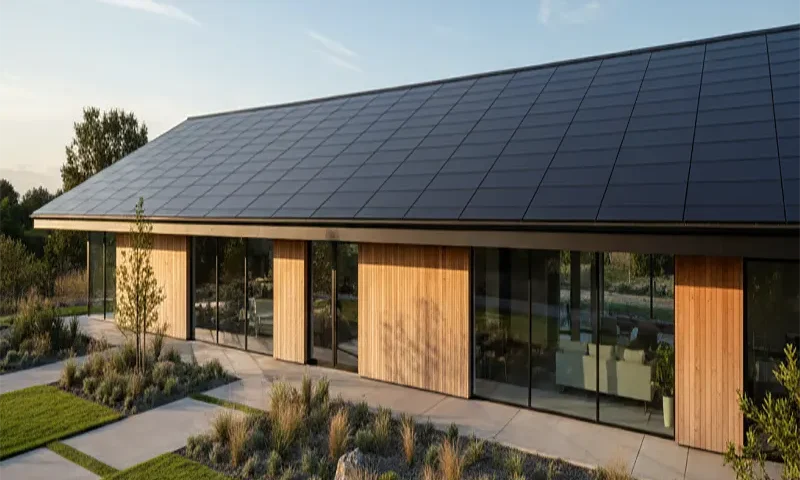
For decades, the adoption of solar energy was often a compromise between environmental conscience and architectural integrity. Homeowners were forced to choose between carbon neutrality and the visual harmony of their rooflines. We are now firmly past the “Bolt-On” era. The traditional blue-black rectangles of Building-Applied Photovoltaics (BAPV), held aloft by unsightly aluminum rails, are being replaced by a more elegant solution: Building-Integrated Photovoltaics (BIPV).
In 2026, the roof is no longer just a passive shield against the elements; it is an active, power-generating skin. BIPV represents the ultimate convergence of structural engineering and renewable energy, where the solar cell is the building material itself.
The 2026 BIPV Technology Landscape
The transition from “solar panels” to “solar surfaces” has been driven by three primary technological breakthroughs that have matured significantly this year.
1. Solar Tiles and Modern Shingles
Companies like Tesla and GAF Energy have refined the solar shingle to the point of being indistinguishable from premium traditional materials. Whether mimicking the deep texture of Tuscan clay or the sleek, overlapping lines of slate, these tiles utilize high-strength tempered glass that is both a protective shingle and a high-efficiency solar cell.
2. Thin-Film Integration (CIGS)
For modern homes featuring curved rooflines or non-linear geometry, Copper Indium Gallium Selenide (CIGS) thin-film technology has become the gold standard. Unlike rigid crystalline silicon, CIGS can be manufactured on flexible substrates. This allows the solar “skin” to be laminated directly onto standing-seam metal roofs or wrapped around organic architectural forms without breaking the visual plane.
3. Perovskite Tandem Cells: The 2026 Breakthrough
The most significant leap in 2026 is the commercial viability of Perovskite Tandem Cells. By layering perovskite—a material with a highly tunable light-absorption band—over traditional silicon, manufacturers have pushed residential efficiency ratings beyond $25\%$. More importantly for aesthetics, this technology allows for transparent and semi-transparent “solar glass,” enabling skylights and atriums to generate power while maintaining neutral interior lighting.
Aesthetics as a Performance Metric
Modern BIPV is defined by its ability to disappear. To achieve this, architects now focus on two specific design elements:
MorphoColor and Custom Palettes
Drawing inspiration from the iridescent wings of the Morpho butterfly, researchers developed MorphoColor technology. By using a specialized nanostructured surface coating, the roof can reflect specific narrow-band wavelengths of light to appear in various colors (greens, grays, or even terracotta) while allowing the rest of the solar spectrum to pass through to the cell. This results in a vibrant, matte finish that hides the “grid” of the solar cells with an efficiency loss of less than $2\%$.
Hidden Hardware and Back-Contact Designs
The “busy” look of old solar panels was largely due to the silver busbars (wires) running across the top of the cells. 2026 BIPV modules utilize All-Back Contact (ABC) technology, moving all electrical circuitry to the rear of the cell. This creates a deep, uniform “obsidian” look that complements modern minimalist architecture.
Structural and Economic Synergy
While the upfront cost of BIPV is higher than traditional shingles, the total cost of ownership tells a different story. BIPV serves a dual function: it is both your roofing material and your power plant.
| Feature | BAPV (Traditional Bolt-On) | BIPV (Integrated) |
| Aesthetics | Visible racks, wiring, and gaps. | Seamless, flush-mounted, uniform. |
| Installation | Two-step (Roof first, then solar). | One-step (The roof is the solar). |
| Durability | Subject to wind-load and debris trap. | Class A Fire Rated; Impact resistant. |
| Material Savings | None (Requires full roof underneath). | High (Replaces slate/tile/metal). |
| Longevity | 20–25 Years. | 30–40 Years (Matches building life). |
Overcoming the ‘HOA’ and Historical Barrier
Historically, Homeowners Associations (HOAs) and Historical Preservation Societies have been the primary antagonists of residential solar. The “industrial” look of solar panels was often deemed “inconsistent with neighborhood character.”
BIPV has effectively dismantled this barrier. Because solar slate and clay tiles are indistinguishable from their non-solar counterparts from the street, they are increasingly being approved for use in protected historical districts. In 2026, many high-end gated communities have shifted from permitting solar to mandating it, provided it meets the “invisible energy” standard of BIPV.
The Self-Sustaining Silhouette
As we move toward a future of decentralized energy, the home must become a producer rather than just a consumer. BIPV turns the roof into a sophisticated engine of autonomy without sacrificing the aesthetic soul of the architecture. By integrating power generation into the very fabric of our homes, we are no longer “adding” green technology—we are building it.
2026 Buyer’s Checklist for BIPV Systems
- Efficiency Rating: Ensure the tandem or CIGS cells are rated at least $22\%$ to $25\%$ to maximize power in a limited footprint.
- Thermal Coefficient: Look for a low temperature coefficient ($P_{max}$). Since BIPV sits flush against the roof, heat dissipation is key. Aim for $\approx -0.29\%/^\circ C$.
- Warranty Alignment: Confirm the “Power Warranty” (generation) matches the “Product Warranty” (weatherproofing), ideally 30 years.
- Inverter Compatibility: Opt for micro-inverters or DC optimizers to mitigate shading issues inherent in complex roof geometries.

