
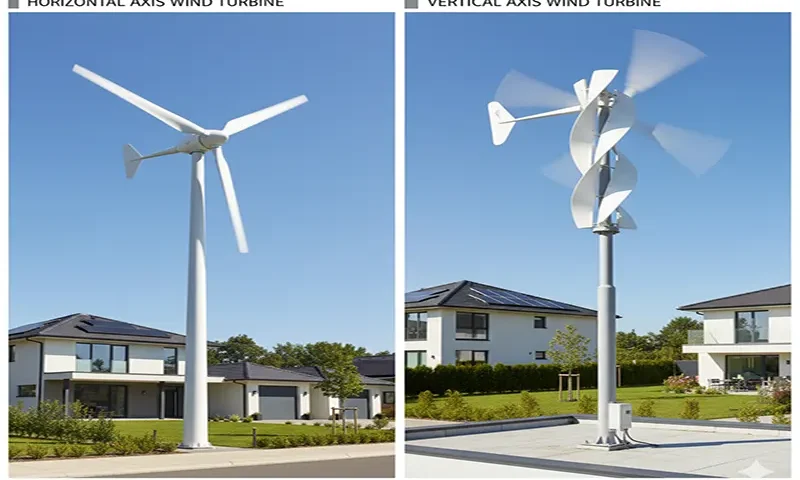
As we move further into 2026, the decentralization of the energy grid has transformed from a futuristic concept into a backyard reality. While solar panels have long dominated the residential landscape, wind energy is seeing a massive resurgence thanks to quieter, more efficient turbine designs. For the homeowner, the primary dilemma is no longer “to wind or not to wind,” but rather which geometry is best suited for their specific environment: the traditional Horizontal Axis Wind Turbine (HAWT) or the modern Vertical Axis Wind Turbine (VAWT).
Choosing the wrong turbine can lead to a “white elephant” on your roof—a machine that spins but never produces enough torque to overcome its own internal friction. Understanding the physics and situational advantages of each is critical to making an informed investment.
The Physics of Wind: The Betz Limit
Before comparing designs, we must address the fundamental law of wind energy. Regardless of design, no turbine can capture 100% of the kinetic energy in the wind. This is known as the Betz Limit.
The theoretical maximum power coefficient ($C_p$) for any wind turbine is approximately 59.3%. The power produced is governed by the equation:
$$P = \frac{1}{2} \rho A v^3 C_p$$
Where:
- $\rho$ is air density.
- $A$ is the swept area of the blades.
- $v$ is the wind velocity.
- $C_p$ is the power coefficient (efficiency).
While HAWTs generally operate closer to the Betz Limit in ideal conditions, VAWTs often perform better in the “dirty,” turbulent air found in residential neighborhoods.
HAWT: The Traditional Powerhouse
Horizontal Axis Wind Turbines are the “pinwheels” we see on massive wind farms. They operate on a lift-based principle where the blades must be pointed directly into the wind to generate power.
Advantages
- High Efficiency: In areas with steady, laminar (smooth) wind, HAWTs are the champions. They reach much higher $C_p$ values because the entire length of the blade is working to extract energy simultaneously.
- Lower Cost per Watt: Because the technology is mature and the physics are straightforward, you generally get more “bang for your buck” in terms of raw energy output per dollar spent on the turbine itself.
Disadvantages
- The Need for ‘Clean’ Air: HAWTs require a high tower (usually 30+ feet) to get above the “boundary layer” of turbulence caused by trees and houses.
- The Yaw Mechanism: Because wind changes direction, HAWTs require a tail fin or a motorized “yaw” system to turn the turbine. In small-scale residential models, this is a common point of mechanical failure.
- Noise and Vibration: The tips of HAWT blades move faster than the wind itself, creating a distinct “whooshing” sound that can irritate neighbors.
VAWT: The Urban/Suburban Disruptor
Vertical Axis Wind Turbines feature a main rotor shaft set vertically. They are often compared to an eggbeater or a DNA helix.
1. The Two Faces of VAWTs
- Savonius (Drag-based): These look like curved scoops. They are slow-moving but have high torque. They are excellent for pumping water or starting in very low winds, but they have low top-end efficiency.
- Darrieus (Lift-based): These use airfoil-shaped blades that generate lift. They are much more efficient than Savonius models but often require a “kickstart” to begin spinning.
Advantages
- Omni-directional: VAWTs don’t care which way the wind is blowing. They capture wind from $360^\circ$ without a yaw mechanism, making them perfect for gusty, shifting urban winds.
- Maintenance: The heavy components—the generator and gearbox—are located at the base of the unit at ground level. You don’t need a crane to fix a VAWT.
- Quiet and Wildlife Friendly: They rotate at lower speeds, making them significantly quieter and easier for birds to see and avoid.
Disadvantages
- Lower Peak Efficiency: Much of a VAWT’s rotation involves the blades moving “back” against the wind, which creates drag and lowers overall $C_p$.
- Pulsating Torque: As the blades rotate, they experience varying forces that can lead to structural fatigue over many years.
Installation Reality Check: Which Is Right for You?
The “better” turbine is entirely dependent on your Obstruction Zone.
The Rural Choice (The HAWT Winner)
If you own an acre or more with no tall trees or buildings within 300 feet, a HAWT is the clear winner. You can mount it on a tall, guy-wired tower where it can access the smooth, high-velocity winds that exist 40 feet up.
The Residential/Roof Choice (The VAWT Winner)
In a suburban backyard or mounted to a roof, the wind is “turbulent.” It tumbles over rooflines and swirls around fences. A HAWT will spend all its time “hunting” for the wind (yawning back and forth), losing efficiency. A VAWT thrives here, catching every gust from every direction. Furthermore, VAWTs produce less gyroscopic vibration, which is crucial if the unit is physically attached to your home’s structure.
Comparison Table: HAWT vs. VAWT
| Feature | HAWT (Horizontal) | VAWT (Vertical) |
| Ideal Setting | Open fields / Rural | Urban / Suburban / Rooftop |
| Efficiency ($C_p$) | High ($35\% – 45\%$) | Mid ($20\% – 30\%$) |
| Noise Level | Moderate to High | Low / Silent |
| Wind Direction | Must face the wind (Yaw) | Any direction (Omni) |
| Maintenance | Difficult (Tower climb) | Easy (Ground level) |
| Start-up Wind Speed | High ($\approx 7-9$ mph) | Low ($\approx 4-6$ mph) |
Choosing Your Breeze
The 2026 home energy landscape is about diversification. If you have the space to go high, the Horizontal Axis Wind Turbine offers the best ROI and raw power. However, for the modern eco-home on a standard lot, the Vertical Axis Wind Turbine is the superior neighbor; it is quiet, mechanically simpler, and turns chaotic urban gusts into consistent, usable power.
Before purchasing, always check your local zoning laws regarding “tip height” and perform a wind audit to ensure your average wind speed is at least 8-10 mph—the threshold where wind energy begins to truly pay for itself.

