
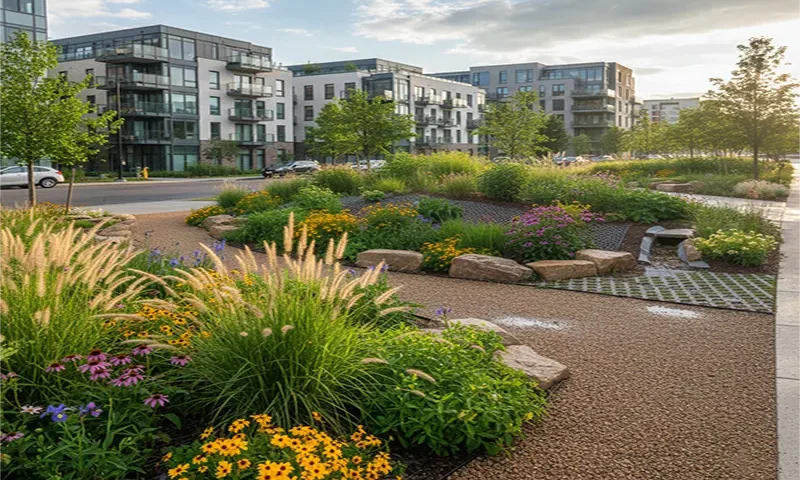
The year 2026 has solidified a new paradigm in urban planning: the “Sponge City.” As cities face the compounding pressures of the Urban Heat Island (UHI) effect and increasingly volatile precipitation patterns, the traditional “gray” infrastructure of concrete pipes and sewers is no longer sufficient. Enter Green Stormwater Infrastructure (GSI)—specifically the climate-resilient rain garden.
A modern rain garden is not merely a collection of water-loving plants; it is a sophisticated bioretention system designed to bridge the gap between two environmental extremes: 48 hours of total soil saturation followed by weeks of intense, reflective urban heat. Success in this dual-stress environment requires a shift from ornamental selection to a rigorous “adaptive native” philosophy.
The Bioretention Anatomy: Engineering for Life
To the casual observer, a rain garden looks like a shallow flower bed. Below the surface, however, it is a high-performance filter. A resilient cell typically consists of:
- Engineered Soil Media (ESM): Usually a mix of 60–80% sand and 20–40% organic compost or expanded shale fines to ensure rapid infiltration.
- The Ponding Area: A depression roughly 6–10 inches deep that holds water during a peak event.
- The Deep Root Network: The “engine” of the system. Native prairie species have root systems that can reach 10–15 feet deep, creating macropores that facilitate drainage even in heavy clay soils.
Selection Criteria: The ‘Adaptive Native’ Philosophy
In 2026, designers have moved away from static plant lists toward three key performance metrics:
1. Inundation and Xeric Resilience
The “Goldilocks” plant for a rain garden must be a generalist. It needs to handle “wet feet” (hypoxia) during a storm but also possess xeric (drought) traits to survive the bake of a mid-August dry spell.
2. Phytoremediation Potential
Urban runoff is a chemical cocktail of heavy metals (Lead $Pb$, Cadmium $Cd$), excess nutrients (Nitrogen and Phosphorus), and hydrocarbons. Resilient palettes prioritize “hyperaccumulators”—plants that can absorb these toxins into their tissues without dying, effectively cleaning the water before it reaches the groundwater table.
3. High Alkalinity Tolerance
Street runoff often carries dissolved salts and lime from concrete, raising the soil $pH$. Climate-resilient palettes must favor species that remain stable in alkaline conditions ($pH > 7.5$).
Plant Palettes for 2026 Resilience
A resilient garden is organized into three functional zones based on their relationship to the water’s “high-tide” mark.
Zone A: The Deep Basin (The Inundation Workhorses)
These plants live at the lowest point. They must be able to withstand being submerged for up to 48 hours.
- Sedges & Rushes: Carex pendula (Great Sedge) and Juncus effusus (Soft Rush) provide the structural “bones” and excellent nutrient uptake.
- Perennials: Iris versicolor (Blue Flag Iris) and Asclepias incarnata (Swamp Milkweed) add vibrant color and support 2026 pollinator corridors.
Zone B: The Mid-Slope (The Flex Players)
This zone is the most volatile—frequently wet but often dry.
- Shrubs: Cornus sericea (Red Osier Dogwood) offers winter interest and aggressive root growth to stabilize the slope.
- Wildflowers: Eutrochium purpureum (Joe-Pye Weed) and Monarda fistulosa (Bee Balm) handle fluctuating moisture levels with ease.
Zone C: The Upland Border (The Heat Shields)
The margin of the garden rarely floods but must act as a buffer against urban heat.
- Grasses: Panicum virgatum (Switchgrass) is a four-season wonder that acts as a physical barrier to wind and trash.
- Drought Stars: Echinacea purpurea (Purple Coneflower) and Rudbeckia hirta (Black-eyed Susan) provide high-albedo foliage to help cool the immediate microclimate.
Technical Comparison: 2026 Performance Metrics
| Species Category | Inundation Limit | Drought Tolerance | Pollutant Removal (N/P) |
| Sedges (Carex) | 72+ Hours | Moderate | High (Nitrogen) |
| Milkweeds (Asclepias) | 48 Hours | High | Medium |
| Dogwoods (Cornus) | 24 Hours | High | High (Phosphorus) |
| Switchgrass (Panicum) | 12 Hours | Exceptional | High (Sediment) |
Maintenance and Smart Tech Integration
The rain garden of 2026 is a “smart” landscape.
- Soil Moisture Sensors: Low-cost IoT sensors now allow municipal crews to monitor “clogging” in real-time. If a garden stays saturated for more than 72 hours, it triggers an automated maintenance ticket to check for silt buildup.
- Lasagna Planting: A major trend for 2026 involves layering bulbs (like Camassia) beneath summer perennials. This ensures that the garden is biologically active during the early spring “snowmelt” season when traditional perennials are still dormant.
From Aesthetic to Infrastructure
Urban rain gardens have graduated from “community beautification” to “critical infrastructure.” By utilizing climate-resilient plant palettes, we are creating a city that doesn’t just survive the storm, but thrives because of it. These gardens turn a liability (stormwater) into an asset (irrigation for biodiversity), ensuring our urban centers remain livable in an age of climate extremes.

