
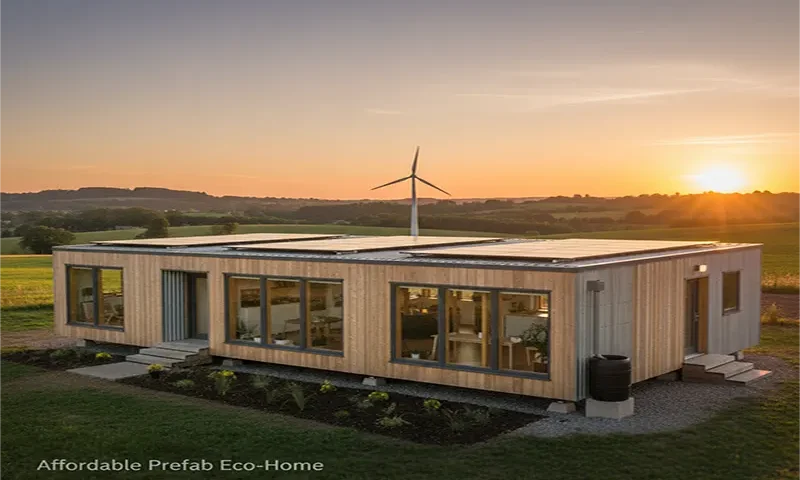
In 2026, the intersection of the housing affordability crisis and the climate emergency has reached a tipping point. Traditional “stick-built” construction—long the standard for residential housing—is increasingly viewed as inefficient, wasteful, and prohibitively expensive. The solution is no longer found in the slow, weather-dependent chaos of a traditional job site, but in the precision of the factory floor.
The modern prefab (prefabricated) revolution is not about the “mobile homes” of the past. It is about industrialized construction (IC): a method that treats home building with the same technological rigor as aerospace engineering. By shifting construction to a controlled environment, we can finally achieve the “triple bottom line”: homes that are affordable to buy, cheap to operate, and gentle on the planet.
The Prefab Revolution: The Precision Advantage
The environmental argument for prefab starts with waste reduction. In traditional construction, roughly 10% to 15% of materials delivered to a site end up in a landfill due to weather damage, theft, or cutting errors. In a factory setting, CAD-integrated machinery ensures that every board and panel is cut with millimeter precision.
This “Precision Advantage” allows for:
- Reduced Material Waste: Off-cuts are recycled or repurposed within the factory.
- Accelerated Timelines: Site preparation (foundations and utilities) happens simultaneously with the home’s construction, cutting total project time by up to 50%.
- Superior Air Sealing: It is much easier to achieve the airtightness required for “Passive House” standards when you are sealing joints in a dry, indoor environment.
Measuring the Footprint: Embodied vs. Operational Carbon
To truly understand a home’s impact, we must look at two distinct metrics.
Embodied Carbon
This is the “upfront” carbon cost—the CO₂ emitted during the mining, harvesting, manufacturing, and transportation of building materials. Prefabrication lowers this by optimizing logistics and favoring carbon-sequestering materials.
Operational Carbon
This is the carbon emitted during the life of the home (heating, cooling, lighting). Because prefab homes are built to tighter tolerances, they require significantly less energy to maintain a comfortable temperature.
The Carbon Payback: A high-performance prefab home might have slightly higher embodied carbon initially (due to high-tech insulation or triple-pane glass), but its superior efficiency ensures a “carbon payback” within 5–7 years of operation.
Key Materials for Low-Carbon Prefab
The “eco” in eco-friendly prefab comes from the choice of the structural “skeleton.” In 2026, three materials dominate the low-carbon market:
1. Mass Timber and Cross-Laminated Timber (CLT)
Wood is nature’s carbon vault. While growing, trees absorb $CO_2$. When used in CLT panels, that carbon is locked away for the life of the building.
As a rule of thumb, $1\ m^3$ of spruce wood sequesters approximately $1\ tCO_2$. By replacing concrete or steel with CLT, a prefab home can actually have a negative carbon footprint at the time of assembly.
2. Hempcrete Panels
Hempcrete is a bio-composite made of the inner woody core of the hemp plant mixed with a lime-based binder. It is carbon-negative, highly insulating, and naturally fire-resistant. In 2026, many prefab companies are offering “panelized” hempcrete kits that provide incredible thermal mass.
3. Recycled Steel Framing
For areas prone to termites or wildfires, recycled steel is the preferred eco-choice. While it has higher embodied carbon than wood, its 100% recyclability at the end of the home’s life makes it a circular economy winner.
Three Affordable Prefab Archetypes
Depending on your budget and site, prefab generally falls into three categories:
The Modular ‘Plug-and-Play’
These are fully finished “boxes” delivered by truck. All interior finishes, plumbing, and electrical are pre-installed. You simply “plug” them into your foundation. This is the fastest route to a new home and offers the most predictable pricing.
The Panelized Kit
Instead of a whole room, you receive a flat-packed set of Structural Insulated Panels (SIPs).
This method reduces shipping costs (you can fit an entire house on one or two trucks) and allows for more custom floor plans. It is the “IKEA model” of housing, requiring a local crew or a very dedicated DIY-er to assemble.
The ADU (Accessory Dwelling Unit) Hybrid
Many homeowners are using small-scale prefab ADUs to add density to existing lots. These 400–800 sq. ft. homes are the testing ground for the most advanced eco-tech, often featuring off-grid solar arrays and greywater recycling as standard.
Cost-Saving Strategies Without Cutting Corners
Affordability in prefab comes from standardization, not cheapness. By using “standard parts,” manufacturers can buy in bulk and pass the savings to you.
- Standardized Spans: Design your floor plan around standard material lengths (e.g., 8′, 10′, or 12′ increments) to eliminate custom cutting costs.
- Passive Solar Orientation: Orienting your prefab to face the sun is a “free” upgrade that can reduce heating bills by $30\%$.
- Thermal Envelope: Prioritize the “shell.” It is much cheaper to install high-R value insulation during factory assembly than to try and upgrade it later.
Buyer’s Comparison: Stick-Built vs. Prefab (2026 Data)
| Feature | Traditional Stick-Built | Modern Prefab (2026) |
| Average Cost per Sq. Ft. | $250 – $450+ | $180 – $350 |
| Construction Time | 9 – 18 Months | 3 – 6 Months |
| Waste Generation | High ($15\%+$) | Low ($<2\%$) |
| Energy Performance | Variable | High (Standardized) |
| Carbon Impact | High Embodied Carbon | Low/Negative (Bio-materials) |
Overcoming the ‘Hidden Costs’
While the “house” might be affordable, remember that Land + Site Work usually accounts for an additional $20\%$ to $40\%$ of your total budget.
- Foundations: Not all prefabs can sit on a simple slab; some require piers or crawlspaces.
- Utility Hookups: Bringing power, water, and septic to a remote “eco-lot” can cost between $10,000$ and $30,000$.
- Local Zoning: Always check if your municipality allows “Modular” or “Panelized” homes—most do in 2026, but some historic districts still lag behind.
The Future is Factory-Built
Affordable prefab housing is no longer a niche market for the “tiny house” enthusiast. It is a sophisticated, scalable solution for anyone who wants a high-design, low-impact lifestyle without a million-dollar price tag. By choosing prefab, you are investing in a home that is built with machine precision, insulated for a changing climate, and constructed from materials that help heal the planet rather than harm it.

