
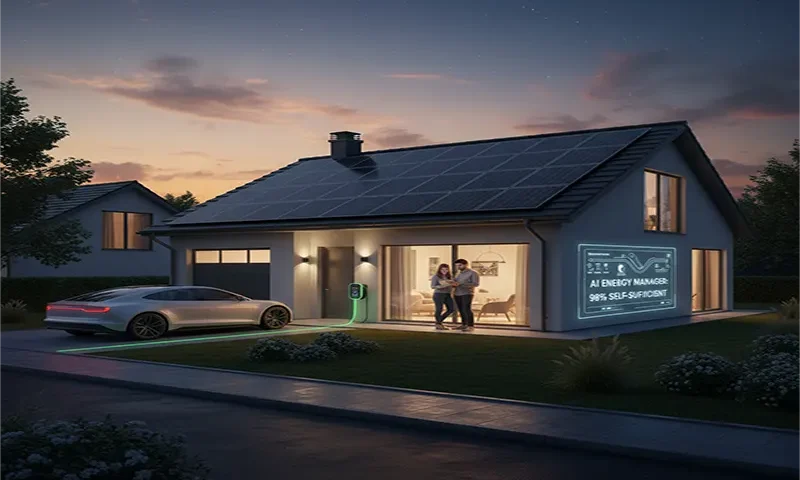
For decades, home solar was a passive investment: you installed panels, and they fed power to your toaster or the grid. But as we move through 2026, the paradigm has shifted from passive consumption to predictive orchestration. The home is no longer just a building; it is a sophisticated microgrid.
The catalyst for this transformation is the convergence of AI-Native Home Energy Management Systems (HEMS) and Vehicle-to-Home (V2H) charging. By treating the electric vehicle (EV) as a massive, mobile battery and the home as an intelligent “energy brain,” homeowners are achieving a level of energy sovereignty previously reserved for utility-scale operations.
The Engine: AI Orchestration and Predictive Analytics
The “smart” homes of five years ago relied on simple “if-then” rules. Today’s AI-powered HEMS utilize predictive analytics to make hundreds of decisions per hour. These systems don’t just see that the sun is shining; they understand why it matters.
1. Forecasting Generation and Demand
Modern HEMS integrate with high-resolution satellite arrays and hyper-local weather APIs. By analyzing the exact density and speed of approaching cloud cover, the AI can predict solar yield 24 to 48 hours in advance. Simultaneously, machine learning algorithms create a “digital twin” of your household behavior, learning that Tuesday is a heavy laundry day or that the EV usually needs a 40% boost by Wednesday morning.
2. Dynamic Tariff Arbitrage
With the 2026 mandate for dynamic electricity tariffs across many regions, electricity prices now fluctuate every 15 minutes. AI agents act as financial arbitragers, automatically buying grid power when prices are low—or even negative during high-renewable periods—and discharging stored energy from the EV or home battery when rates peak.
V2H (Vehicle-to-Home): The 100kWh Backup
The most significant shift in 2026 is the mainstream adoption of bidirectional charging. While a standard home battery typically stores $10\text{–}15\text{ kWh}$, an average EV battery holds $70\text{–}100+\text{ kWh}$. This is enough energy to power a typical high-efficiency home for up to five days.
The Mechanics of V2H
New 2026 hardware, such as the Enphase IQ Bidirectional DC Charger, utilizes “Black Start” technology. In the event of a grid failure, the system instantaneously creates a localized microgrid, using the EV’s massive reserve to keep essential loads—and even high-draw appliances like heat pumps—running without interruption.
Machine Learning for Battery Longevity
A common concern with V2H is “cycling” the expensive EV battery to power the home. AI addresses this through State-of-Health (SoH) optimization.
- Micro-Cycling: Instead of deep discharges, the AI performs shallow, intelligent cycles that stay within the battery’s “comfort zone” (typically $20\%\text{–}80\%$ State-of-Charge).
- Thermal Management: By monitoring cell temperature in real-time, the AI ensures that V2H discharge only occurs when the battery is at an optimal thermal state, significantly slowing chemical degradation.
$$Savings = \sum (Rate_{peak} \times P_{dis}) – (Rate_{off} \times P_{chg})$$
The formula above illustrates the basic logic of the AI’s arbitrage: the goal is to maximize the delta between the cost of charging during off-peak hours ($P_{chg}$) and the value of the energy discharged to the home or grid during peak windows ($P_{dis}$).
Virtual Power Plants (VPPs) and the Grid
In 2026, your home is also an income generator. By participating in a Virtual Power Plant, you allow a utility or aggregator to briefly “borrow” a small percentage of your EV’s capacity to stabilize the national grid during demand spikes. In return, homeowners receive “grid service payments,” which can offset the cost of the vehicle itself.
| Feature | Rule-Based HEMS (Older) | AI-Native HEMS (2026) |
| Logic | Fixed schedules (e.g., “Charge at 2 AM”) | Predictive (e.g., “Charge now; prices are negative”) |
| Weather | Not integrated | Real-time satellite & cloud tracking |
| Battery Health | Basic limits | ML-driven SoH and thermal protection |
| Grid Interaction | Passive | Active VPP/V2G participation |
| User Effort | Manual configuration | Fully autonomous “Energy Agent” |
The Self-Sustaining Silhouette
The marriage of AI and V2H has turned the electric vehicle from a transportation cost into an energy asset. By 2026, the most advanced homes are no longer “balancing” their energy; they are letting an autonomous agent do it for them. This transition provides more than just financial ROI; it offers the peace of mind that comes from knowing your home is a resilient, self-sustaining fortress in an increasingly volatile energy landscape.

