
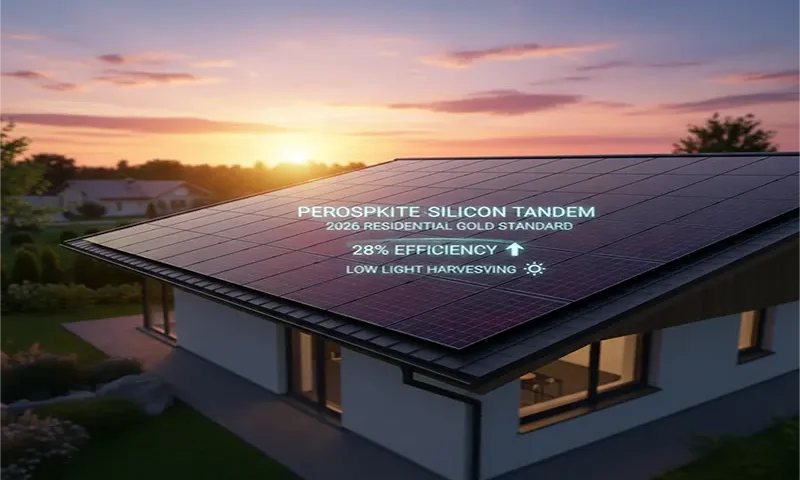
For decades, the solar industry has been chasing the “30% barrier.” Traditional silicon panels, which currently power over 95% of the world’s rooftops, are fast approaching their theoretical ceiling—known as the Shockley-Queisser (S-Q) limit. As we navigate 2026, the breakthrough that once lived only in laboratories has finally arrived on the residential market: Perovskite-Silicon Tandem Solar Panels.
By stacking a perovskite layer on top of a standard silicon base, manufacturers are now shipping modules that produce up to 25% more power from the same roof footprint. For the 2026 homeowner, this technology represents the transition from “standard” efficiency to “ultra-high” yield.
1. Breaking the Shockley-Queisser Limit
The fundamental limit for a single-junction silicon solar cell is approximately $29.4\%$. In real-world manufacturing, this translates to module efficiencies that top out around $23\text{–}24\%$. Tandem cells bypass this by using a “double-decker” architecture.
How Tandem Cells Work
Perovskite materials are “tunable,” meaning they can be engineered to absorb high-energy blue and ultraviolet light that silicon typically wastes as heat.
- The Top Layer (Perovskite): Captures high-energy, short-wavelength photons.
- The Bottom Layer (Silicon): Captures lower-energy, long-wavelength infrared photons that pass through the top layer.
By splitting the solar spectrum, tandem modules in 2026 are reaching commercial efficiencies of $26.9\%\text{–}28.5\%$, with laboratory prototypes already shattering the $34\%$ mark.
2. Top Residential Players & Modules in 2026
As of early 2026, three major manufacturers have taken the lead in bringing tandem technology to the consumer market.
Oxford PV: The Centaur™ Series
The UK/German-based Oxford PV was the first to ship commercial-sized tandem modules. Their 2026 Centaur™ residential series features a 60-cell double-glass design.
- Module Efficiency: Certified at $26.9\%$.
- Power Output: Upwards of $450\text{W}$ in a standard residential form factor.
- Key Advantage: Compatible with standard racking and balance-of-system (BOS) components.
Hanwha Qcells: Q.ANTUM Tandem
Qcells has leveraged its massive US-based manufacturing presence to scale its Q.ANTUM Tandem technology.
- Current Status: In late 2024, they achieved a record $28.6\%$ on mass-producible M10-sized cells.
- 2026 Offering: Their residential pilot modules are targeting a $27.5\%$ module-level efficiency, specifically designed for extreme durability in diverse climates.
LONGi Solar: The Hi-MO T Series
A global leader in silicon, LONGi has integrated perovskites into their Hi-MO T line.
- Performance: While their lab records have hit $34.85\%$, their 2026 residential panels focus on stability, offering a $26.5\%$ efficiency with an emphasis on low degradation.
3. Overcoming the ‘Stability Gap’
Historically, perovskites were sensitive to moisture and oxygen. To reach the 2026 market, manufacturers had to solve the Stability Gap to meet the 25-year lifespan expected by homeowners.
- Advanced Encapsulation: 2026 tandem panels utilize Double-Glass (Bifacial) construction. This “glass-on-glass” sandwich prevents moisture ingress far more effectively than traditional plastic backsheets.
- Certification: Leading modules have now passed the IEC 61215 and IEC 61730 stress tests, which simulate 20+ years of environmental wear.
- Warranties: Most 2026 tandem products now offer a 20-to-25-year performance guarantee, typically promising at least $80\text{–}85\%$ of original output at the end of the term.
4. Economics: ROI and Levelized Cost of Energy (LCOE)
While tandem panels carry a “premium” price tag—often $15\text{–}20\%$ higher than premium TOPCon or HJT panels—their financial profile is superior for space-constrained roofs.
The LCOE Calculation
The true value of a solar investment is found in its Levelized Cost of Energy (LCOE):
$$LCOE = \frac{\text{Total Life Cycle Cost}}{\text{Total Lifetime Energy Production}}$$
Because tandem panels produce significantly more $kWh$ per square meter, they reduce the Balance of System (BOS) costs. You need fewer rails, fewer microinverters, and less labor to achieve the same total system size. In 2026, a tandem system often reaches “payback” $1\text{–}2$ years faster than a standard system if roof space is limited.
5. Technical Comparison: Tandem vs. Standard
| Feature | N-Type TOPCon (Standard 2026) | Perovskite-Silicon Tandem (2026) |
| Module Efficiency | $22.5\%\text{–}24\%$ | $26\%\text{–}28.5\%$ |
| Typical Wattage | $400\text{W}\text{–}430\text{W}$ | $480\text{W}\text{–}520\text{W}$ |
| Space Required | $100\%$ Base | $75\%\text{–}80\%$ of Base |
| Degradation | $0.4\%/\text{year}$ | $0.5\%\text{–}0.6\%/\text{year}$ |
| Warranty | $25\text{–}30$ Years | $20\text{–}25$ Years |
6. Installation Considerations for 2026
If you are installing tandem panels this year, there are two critical technical factors to discuss with your contractor:
- Inverter Precision: Tandem cells have unique voltage-current (I-V) curves. Ensure your system uses High-Precision MPPT (Maximum Power Point Tracking) inverters, such as the 2026 models from Enphase or SolarEdge, to fully capture the high-energy gains.
- Bifacial Yield: Many tandem panels are now bifacial. If you have a light-colored or “cool” roof (high albedo), you can gain an additional $5\text{–}10\%$ in power as light reflects into the back of the panel.
Is 2026 the Year to Switch?
2026 marks the first year that Perovskite-Silicon tandem panels are a “safe” bet for residential use. If you have a small roof and high energy demands (such as multiple EVs or a heat pump), the extra $4\text{–}5\%$ efficiency jump is a game-changer.
While we expect efficiencies to hit $30\%$ by 2028, the current crop of certified modules from Oxford PV and Qcells offers a mature, high-yield solution for those ready to move beyond the limits of silicon.

