
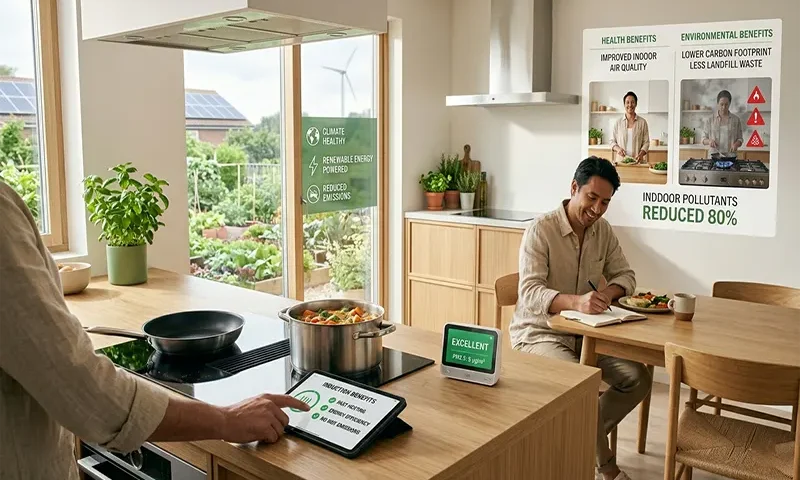
For decades, the gas flame was considered the hallmark of the professional kitchen, a symbol of heat and precision. However, a significant shift is underway in home design and residential policy. As we gain a deeper understanding of indoor air quality and the long-term impacts of fossil fuel combustion, the kitchen is undergoing a quiet revolution: the transition from gas to induction.
Induction cooking uses electromagnetic energy to heat cookware directly, rather than heating the air around a vessel with a flame. This seemingly simple technological shift carries profound implications for both family health and the broader environmental landscape.
The Health Case: Cleaning the Indoor Atmosphere
The most compelling argument for switching to induction is the immediate impact on indoor air quality. When we ignite a gas stove, we are introducing a controlled combustion process into our living space. This process releases a cocktail of pollutants, most notably nitrogen dioxide ($NO_2$), carbon monoxide, and formaldehyde.
- The Asthma Connection: Peer-reviewed research has consistently linked the use of gas stoves in homes with an increased risk of childhood asthma. $NO_2$ is a known respiratory irritant that inflames the airways. Even when the stove is turned off, gas ranges can leak methane—a potent greenhouse gas—into the home.
- Particulate Matter: Gas combustion releases fine particulate matter ($PM_{2.5}$) that can penetrate deep into the lungs. By removing the combustion source entirely, induction cooktops eliminate these emissions at the source, creating a safer environment for children, the elderly, and anyone with respiratory sensitivities.
The Environmental Impact
Beyond the walls of the kitchen, the switch to induction is a critical component of decarbonizing the home. Natural gas is primarily methane, a greenhouse gas with a warming potential significantly higher than carbon dioxide over the short term.
- Infrastructure Leaks: Methane leakage is not just an issue at the point of use; it is a systemic problem throughout the extraction and distribution pipeline. By choosing induction, you stop demanding this fuel, effectively reducing your personal contribution to these upstream emissions.
- The Grid Advantage: Perhaps the most powerful aspect of induction is its synergy with the greening grid. A gas stove will always be a fossil fuel appliance. An induction cooktop, however, is an electric appliance. As our local utility grids continue to integrate more solar, wind, and geothermal power, your kitchen becomes cleaner every year. You are essentially “future-proofing” your home against the inevitable transition away from fossil-fueled infrastructure.
Performance and Safety: A Superior Experience
A common myth persists that gas is necessary for “real” cooking. In reality, the culinary industry has been shifting toward induction for years due to its sheer performance superiority.
- Precision and Speed: Induction cooktops offer nearly instantaneous control. They can bring a pot of water to a boil in roughly half the time of gas, and the “simmer” control is far more stable than the lowest setting on a gas burner, which is prone to flickering or going out.
- Safety: The safety benefits are transformative. Because the cooktop itself does not generate heat—it only induces heat within the metal of the pan—the surface stays relatively cool to the touch. This significantly reduces the risk of burns for children and makes the cleanup process effortless, as spills do not “bake” onto the surface.
| Feature | Gas Cooktop | Induction Cooktop |
| Safety | High (Open flame/gas leaks) | Very High (No flame/cool surface) |
| Speed | Moderate | Exceptional |
| Emissions | $NO_2$, CO, Methane | Zero (at point of use) |
| Maintenance | Difficult (Grates/burners) | Very Easy (Glass surface) |
Addressing the Hurdles
The transition often hits two roadblocks: the need for compatible cookware and the cost of electrical upgrades.
- Cookware: Induction requires ferromagnetic materials (iron or steel). If a magnet sticks to the bottom of your pan, it will work on induction.
- Cost: While the initial outlay for an induction range can be higher, it is important to view this through the lens of 2026 incentives. Many regions currently offer substantial rebates and federal tax credits for home electrification, specifically targeting the replacement of gas appliances. These incentives are designed to bridge the cost gap, making the transition not just environmentally responsible, but economically sound.
The Future-Proof Kitchen
Switching to an induction cooktop is one of the most impactful upgrades a homeowner can make. It is a decision that reconciles the desire for high-performance cooking with the necessity of a healthy indoor environment. By choosing induction, you are not merely replacing an appliance; you are opting out of a combustion-based system that is increasingly recognized as outdated.
As we continue to build for a sustainable future, the kitchen stands as the heart of the home. Ensuring that this space is powered by clean, efficient, and safe technology is a fundamental step in building the homes of tomorrow—today.

