
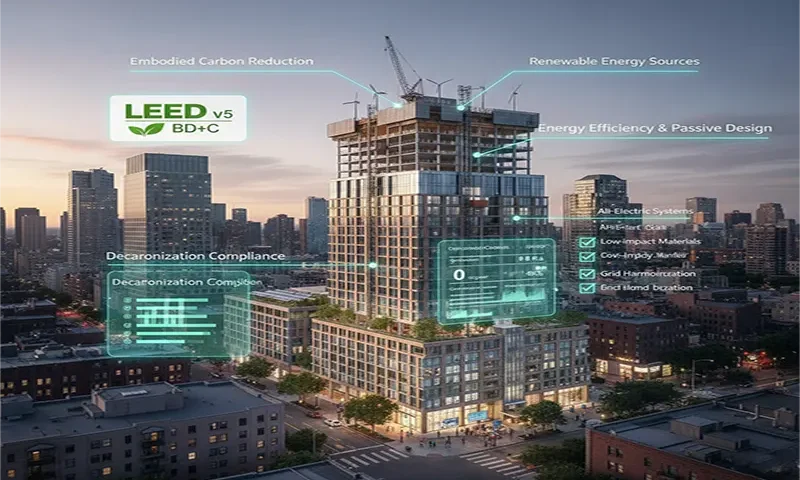
LEED v5 Building Design and Construction (BD+C) Requirements for Decarbonization Compliance
In 2026, the global real estate market has reached a critical juncture. No longer is “green building” defined simply by low-flow faucets or bike racks. With the official rollout of LEED v5, the U.S. Green Building Council (USGBC) has fundamentally recalibrated the world’s most widely used green building rating system to address the climate emergency. LEED v5 BD+C is no longer just a sustainability checklist; it is a rigorous decarbonization framework.
For the first time, Decarbonization accounts for 50% of the total available points in the system. This shift signals a transition from measuring “efficiency” to mandating “performance,” forcing project teams to account for every kilogram of carbon emitted from ground-break to the year 2050.
The 2026 Paradigm Shift: Impact-Driven Scoring
The traditional LEED categories have been reorganized under three core Impact Areas:
- Decarbonization (50%)
- Quality of Life (25%)
- Ecological Conservation (25%)
This restructuring means that a … READ MORE ...
